Tuesday, January 10, 2012

A Seal in the River Lee

Grey Seal (Halichoerus grypus) at Union Quay, Cork City

The River Lee extends some 65 km from the Shehy Mountains to the sea at Cork Harbour (1). It starts becoming estuarine at Cork city: indeed the city was once a series of marshy islands surrounded by brackish water, a fact remembered in the names of parts of the city (The Marsh, Morrisson's Island, etc.) and the name of Cork itself, from the Irish “corcach” meaning bog (1). This estuarine habitat often brings large sea mammals right into the centre of the city, much to bemusement and delight of its residents. While Killer Whales (Orcinus orca) and dolphin species have been recorded in the past (2), the most common large mammals to be seen in the city area of the Lee are seals, both Grey (Halichoerus grypus) and Common (Phoca vitulina). The accompanying picture was taken on Christmas eve, at about 9.30 in the morning of a Grey Seal basking in the river around the Union Quay area of the city. Grey Seals are distinguished from Common Seals by their larger, almost dog-like, snout (4). Males are darker in colour than females and may also be noticeably larger (up to 0.5 m). Indeed, some males can grow quite large, reaching 3 m in length.

References:
  1. Crowley et al. (Eds.), 2005. Atlas of Cork City pp. 7-16
  2. Ryan and Wilson, 2003. The Irish Naturalists' Journal 27 pp. 187-191
  3. Sterry, 2004. Collins Complete Guide to Irish Wildlife p. 28

Wednesday, December 14, 2011

Not Quite an Insect

Campodea spp.
Even though there are only four species present in Ireland (all from the genus Campodea (1)), diplurans are often observed in soils, where they are perfectly adapted to life there feeding on live prey and decaying organic matter amongst the leaf litter. With their lack of eyes, lack of pigment, long tapered bodies and long antennae they resemble miniature centipedes, but their six legs on their three segmented thorax tell another story. Diplurans are hexapods, and while often placed in the class Insecta, they should really be seen as insects' closests relative (2). While sharing many features with insects (body divided into head, thorax and abdomen, three pairs of walking legs, and a segmented abdomen devoid of legs), they are distinguished from insects by having antennae devoid of a chordotonal sensory organ in the pedicel and by the lack of an appendicular ovipositor and of a median unpaired caudal filament (2). Often referred to as 'two pronged bristletails', this name is derived from presence of only one pair of caudal appendages, the cerci. There are about 1000 species of diplurans described present throughout the planet in all but the harshest areas (deserts, polar regions and areas above 3500 metres). Three major lineages exist: Campodeoidea, Projapygoidea, and Japygoidea (3).

References:
  1. Ferriss et al., 2009. Irish Biodiversity: a taxonomic inventory of fauna
  2. Kock, 2009. Encyclopedia of Insects (Second Edition) pp. 281-283
  3. Luan et al., 2004. Pedobiologia 48 pp. 453-459

Saturday, December 3, 2011

What's In A Song?

Technically speaking, birds make two sounds: a call and a song. The call is relatively short and somewhat muted and is used for basic contact or in times of alarm, whereas the song  is a much elaborate and intricate affair and is associated with courtship and mating. Birdsong consists of sequences of smaller discrete units called elements. Groups of elements are combined into intermediate units called syllables, which in turn combine to make songs. If these units, elements and syllables, exist throughout an entire species they are called universal categories (1). 
Male (top) and female Chaffinch (Fringilla coelebs)
The song of the Chaffinch (Fringilla coelebs) is a wonderfully bubbly affair, especially when compared with the simple “pink” that is its call (2). Its song consists of an initial trill of several repeated syllable phrases, followed by a “flourish,” which typically consists of a short phrase of high-pitch elements and one long buzzy element (3). It has been shown that male Chaffinches assess songs differently from females based on the relative length of the trill and the flourish, showing that the differences in the two parts represents a communicative relevance (4). Analysis of Chaffinch song with a dynamic time-warping algorithm showed that the syllables were linked to certain positions within the song and were not randomly distributed (2). This lends further credence to the theory that birdsong has parallels with human language.

References:
  1. Lachlan et al., 2010. Journal of Comparative Psychology  124 pp. 92-108
  2. Sterry, 2004. Collins Guide to Irish Wildlife
  3. Thorpe, 1954. Nature 173 p 465
  4. Leitão et al., 2006.  Animal Behaviour 71 pp. 1289-1296.

Friday, December 2, 2011

Sniffing Out a Meal

Figwort Weevil, Cionus scrophulariae
The wonderfully patterned Figwort Weevil (Cionus scrophulariae) is a fairly common but shy animal in Ireland that can be found on plants of the family Scrophulariaceae. The larvae may also be seen here, covered with a shiny, sticky substance. This is a diffuse peritrophic membrane that acts as a deterent to any potential predators (1). Production of this membrane in the posterior mid-gut stops once the larva has stopped feeding and a new, ribbon-type structures begin to be made which are used to construct cocoons.
Figwort, Scrophularia nodosa
The weevil's main food source is the Figwort (Scrophularia nodosa) from where it gets its name. Figwort is an excellent coloniser, but mainly of waste ground and populations are therefore often scattered across an area. C. scrophulariae can find these populations using odors from Figwort. The larger the patch size of Figwort plants, the stronger the odor and the higher the density of  C. scrophulariae individuals associated with them (2).

References:
  1. Tristram, 1978. Journal of Insect Physiology 24 pp. 391-398
  2. Anderson and Hambäck, 2011. Athropod-Plant Interactions 5 pp. 269-277

Thursday, December 1, 2011

Local Evolution in the Large White Butterfly

Large White Butterfly Larva, Pieris brassicae, feeding
The bane of any gardener attempting to grow a few tasty brassicas, the larvae of the Large White Butterfly (Pieris brassicae) is a rapacious feeder. Reports in the past of 100% crop loss (1) may have been reduced but globally the loss to its main 18 food plants runs to 1% of total yield (2). Such heavy damage by this widespread, Palaerartic species is due to the practice of females laying batches of eggs, as opposed to its close relatives who tend to lay eggs singly (3). The results can be devastating to behold, with plant leaves reduced to skeletal forms.
Large White Butterfly Adult, Pieris brassicae
Like many other insect species, P. brassicae undergoes diapause in response to short photoperiods which serves to outlast periods with unsuitable conditions such as low temperature and low food supplies (4). However, one population of P. brassicae in Andalusia in southern Spain has evolved an additional response to long photoperiods (3). This summer diapause (or aestivation), which is only found in this Spanish population, last three months and represents something of  a major evolutionary novelty, because it cannot have evolved via a gradual transformation of the ancestral photoperiodic response in which only short day-lengths induced diapause. Its role is unclear as the butterfly loses three generations by undergoing aestivation. It has been shown that the attack rate of its main parasitoid, Cotesia glomerata is reduced as a result of aestivation, thus increasing survival rate of the larvae (5).
Large White Butterfly Larvae, Pieris brassicae
References:
  1. Cansdale, 1876. Entomologist 8-9 p. 257
  2. Feltwell, 1978. Journal of Research on the Lepidoptera 17 pp. 218-225
  3. Held and Speith, 1999. Journal of Insect Physiology 45 pp. 587-598
  4. Beck, 1980. Insect Photoperiodism
  5. Pörschmann and Spieth, 2011. Entomological Science 14 pp. 31–36

Monday, November 28, 2011

Invasion of the Egret!

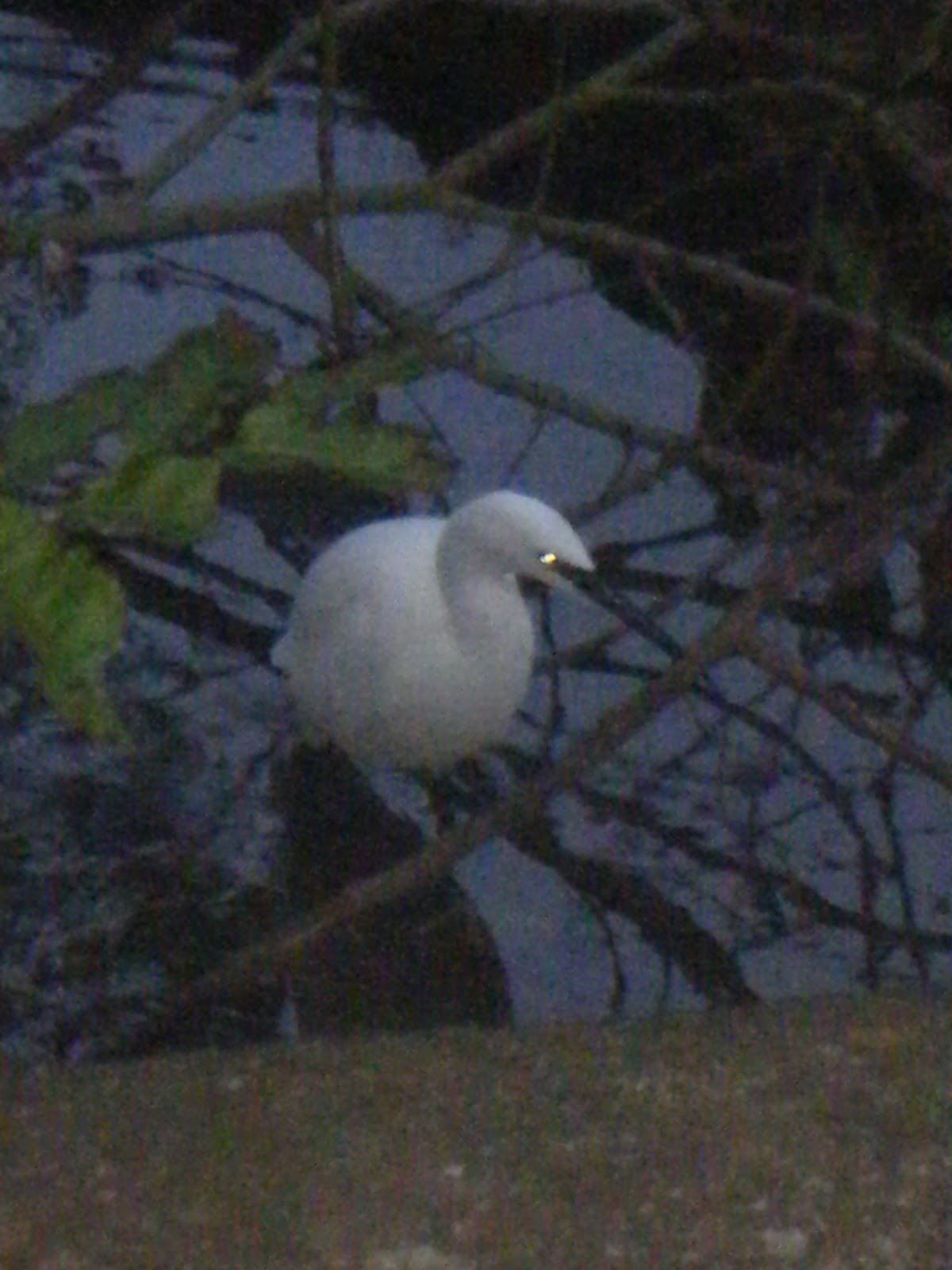
Little Egret, Egretta garzetta
Its easy to see the attraction to the Little Egret (Egretta garzetta). Its snowy-white plumage contrasts beautifully with its black, dagger-like bill. Unfortunately the attraction proved to be the undoing of E. garzetta populations in Britain and Ireland. In the breeding season the adult grows two long nape feathers (1). E. garzetta was hunted to extinction in much of norther Europe for these feathers which were used in the production of hats (2). This example of fashion gone crazy resulted in the death of millions of Little Egrets up to the start of the 20th century when a combination of changing fashion tastes and a growing awareness in conservation reduced the hunting of the bird (3).
E. garzetta became an occasional winter visitor in Ireland after this time and up until late 1980's and early 1990s. Large numbers of autumn migrants in 1995-6 lead to a wintering population of about 60 birds. Finally in 1997 a breeding site of 12 birds was established on the River Blackwater on the border between counties Cork and Waterford (4). Breeding sites have increase since then and now Cork has four further established (at Ballannan Wood, Fota Island, Rostellan and the Atlantic Pond) and one possibly established (Carrigaline) sites (5). In these sites, the birds nest in close porximity to the Grey Heron (Ardea cinerea). While the reestablishment of E. garzetta is a welcome development, the speed which with this has occurred is very interesing: from no birds to six breeding sites in just twenty years.

References:
  1. Sterry, 2004. Collins Guide to Irish Wildlife p. 36
  2. Stubbs, 1910. Zoologist 14 pp. 310-311
  3. Bourne, 2003. British Birds 96 pp. 332-339
  4. Smiddy and Duffy, 1997. Irish Birds 6 pp. 55-56
  5. O'Donoghue and Smiddy, 2008. In Practice p. 14

Come Fly With Me

Migrant Hawker, Aeshna mixta
The Migrant Hawker dragonfly (Aeshna mixta) is a relatively new addition to the odonate fauna of Ireland, with the first sighting being reported in 2000 (1). However, this was during the DragonflyIreland survey of dragonflies and damselflies and it may have been present before this. It has the latest emergence of all dragonflies in Ireland, appearing in in the south and south-east of the country in late July and present till late October. Its flight is quite impressive to behold:- hovering around low-lying vegetation, it can quickly shoot high into nearby treetops with ease. Studies of the flight in Aeshna spp. using both tethered animals and model wings have revealed it to be a very complex process (2). It was seen that Aeshna spp. fly by using unsteady aerodynamic mechanisms to generate leading edge vortices or high lift when needed and that the dragonfly controls the flow mainly by changing the angle of attack of the wings. Unsteady aerodynamics refers to the effects on flight that changes in the air flow or in the position or orientation of a body (in this case a wing).
Migrant Hawker, Aeshna mixta
References:
  1. Nelson and Thompson 2004. The Natural History of Ireland's Dragonflies pp. 193-199
  2. Wang and Sun, 2005. The Journal of Experimental Biology 208 pp. 3785-3804