Friday, January 7, 2011

Clay Tablets, Eclipses and iPhones

A guest post by Ken.

I rose early last Tuesday morning, eager to get a glimpse of the partial solar eclipse. It is indeed an unusual world that we live in, with the natural world mixing with the artistic and the technological world combining both. I had to make my way to the strand in Carrigaline, groggy in mind as well as in spirits. The clouds were all about, the sun not yet risen and not about to show its face even when it did.

I waited from about 8.45am to approximately 9am. The horizon, although lined with forest-covered hills, would have afforded me a beautiful view of the eclipse if it were not for the clouds. My iPhone steadily pumping out the latest Kanye West hip hop tunes, and me waiting for the sun. I had just about given up and was making my way back home when for no reason at all I turned and a break in the cloud showed me a magnificent sight. My first sunrise of the new year 2011 and an opportunity for a partial eclipse event. Of course I had not brought my eclipse viewing glasses. A closed fist would have to do, peeping through it ever so slightly and finally sighting the sun, the orange disc on which all life depends, with a bottom-left portion of it missing, eclipsed by the moon. I was delighted. I even turned off the tunes and tried to snap a picture and although not much is visible this was at least a record of the event.


Partial Solar Eclipse over Carrigaline Strand
 The coincidence in size of the apparent diameters of the Moon and Sun produces a startling event at the Earth's surface which has held mankind in awe. Many civilizations [Babylon, China, Arab dominions, Europe] have recorded these events on clay, parchment or paper and some have survived to today. In fact these records are the only way known of measuring the actual changes in the Earth's rotation over the course of the ancient recorded history. (1)


Solar Eclipse


The clouds gathered again after 10-15 minutes and they decided that that was all I would see. I was glad I had seen that much. We shall not have another one until 2015 in these parts.

Later,

Ken.


References:

1.  L. V. Morrison, F. R. Stephenson, Historical eclipses and the variability of the Earth's rotation, Journal of Geodynamics, Volume 32, Issues 1-2, August-September 2001, Pages 247-265

Thursday, January 6, 2011

Feeding Challenges for the Oystercatcher

Oystercatcher, Haematopus ostralegus
The Oystercatcher (Haematopus ostralegus, the Eurasian or Pied Oystercatcher) is one of the largest, and most striking wading birds in Ireland. A resident here all year round, it tends to stick to undisturbed shores when breeding, but is readily visible outside of this time on beaches and estuaries where large flocks often roost (1). It is plover in shape, but has a distinctive black and white colouring with long pink legs and piercing red eyes. Its stout yellow bill is used to feed on molluscs (predominantly mussels, despite its name) and shows three distinct shapes: pointed, chisel shaped and blunt (2).
Feeding can be quite an ordeal for the Oystercatcher. To begin with, there is stout competition for food to deal with. While the different bill types helps to reduce interspecific competition (2), dominance hierarchies exist at feeding sites where intake by subdominant individuals decreases with increasing bird densities (3). Dominant individuals at these sites suffered no such decrease. Feeding can be further restricted by shortened foraging times due flooded feeding areas. The Oystercatcher has been shown to be more than capable of meeting this challenge. In simulated shorter foraging times, birds spent proportionally more time foraging, shortened their searching time per prey item taken and decreased the time spent handling prey (4). This resulted in no decrease in consumption.

References:
  1. Sterry, 2004 Collins Complete Guide to Irish Wildilfe p. 50
  2. Swennen et al. 1983 Netherlands Journal of Sea Research 17 pp. 57-83
  3. Ens and Goss-Custard, 1984 Journal of Animal Ecology 53, pp. 217-231
  4. Swennen et al., 1989 Animal Behaviour 38 pp. 8-22

Wednesday, January 5, 2011

The Shoveler's Bill

Male Shoveler Duck, Anas clypeata
The Shoveler Duck, Anas clypeata, is a distinctive winter visitor to Ireland, migrating here from France, northern Europe, the Baltic, Russia and even a small population from Iceland (1), with some all-year residents. Both males and females are similar in colouring to its relative the Mallard (A. platyrhynchos), the females being a similar brown colour and the males having a green head and chestnut breast (but with blue forewings) (2), yet are quite different in one dramatic feature: their bill. The bill of the Shoveler is a large, spatulate tool it uses to filter feed aquatic plants and invertebrates (3). A. clypeata moves its bill from side to side as it passes through the water, filtering it as it goes.
Female Shoveler Duck, Anas clypeata, feeding
References:
  1. Arzel et al., 2006 Journal of Ornithology Volume 147 pp. 167-184
  2. Hayman and Hume, 2002 The Birdwatcher's Pocket Guide to Britain and Europe
  3. Kooloos et al. 1989 Zoomorphology Volume 108 pp. 269-290

Tuesday, January 4, 2011

Forestry and the Fir Clubmoss

Fir Clubmoss, Huperzia selago


There are five native Clubmoss and Lesser Clubmoss (Spikemoss) species in Ireland, four of which have ever been recorded in County Cork: Fir Clubmoss, Lesser Clubmoss, Stag's Horn Clubmoss and Marsh Clubmoss. Of these, Fir Clubmoss (Huperzia selago) is by far the most frequent in County Cork and in Ireland as a whole (1). It is found on mountainous grassland, heath, moorland and rocky out crops (2). H. selago gets its common name from its resemblance to a small conifer. The plant consists of green, needle like leaves arranged around the stem. It produces spores, not in 'clubs' or cones as in other Clubmosses, but in small structures known as gemmae on the leaf axils. 
Fir Clubmoss, Huperzia selago

However, O'Mahoney has noted (1) that increases in forestry in upland areas poses a threat to H. selago. Its relatively slow growing pace means that recovery may often be impossible if displaced from an area.

References:
  1. O'Mahoney, 2009 Wildflowers of Cork City and County p. 327
  2. Phillips, 1978 Grasses, Ferns, Mosses and Lichens of Great Britain

Thursday, December 16, 2010

The Thickness of the Flat Periwinkle Shell

Flat Periwinkle, Littorina obtusata
The flat periwinkle Littorina obtusata is a very common grazer of seaweeds on the middle shore around Ireland (1) and is a large constituent of the diet of the common shore crab Carcinus maenas (2). C. maenus feeds on the shellfish by crushing the shell and extracting the periwinkle. The evolution of the shell is though to be driven mainly by the selection pressures associated with such shell crushing predators (3). However Geoffery Trussell proposes that morphological co-evolution between predators and their gastropod prey may be driven by natural selection on reaction norms rather than genetically fixed phenotypes (4). In his study of geographical variation in L. obtusata in the Gulf of Maine, he found that periwinkles in areas with more C. maenas had thicker shells. This result was underlined in a subsequent laboratory experiment when L. obtusata raised in the presence of C. maenas again had much thicker shells. The trade off for better protection was smaller individuals with an accompanied reduction in body growth.
Shore Crab, Carcinus maenas

References:
  1. Chinery 1987, Field Guide to the Wildlife of Britain and Europe p. 200
  2. Ropes 1968, Fishery Bulletin 67 pp. 183-203
  3. Clements et al. 2008, Biology Letters 4 pp. 179–182
  4. Trussell 2000, Evolutionary Ecology Research 2 pp. 803-822

Thursday, December 9, 2010

How to Eat an Insect

A common sight on bogs and heaths throughout west Cork and Kerry, the Large Flowered Butterwort (Pinguicula grandiflora) is one of a number of carnivorous plants native to Ireland (1). On these poorer, wetter soils, carnivory offers an advantage to plants (2) and makes them indicative of such wet soils. Due to the low pH of peaty soils, nutrients become unavailable to plants as they become bound in salts. While it was previously held that the main reason for insectivorous behaviour in plants was to obtain mainly nitrogen (3), it has been shown that in a Pinguicula species, only phosphorus absorbed through the leaves leads to a significant increase in plant biomass (4).

Large Flowered Butterwort, Pinguicula grandiflora
 
So how does P. grandiflora capture insects to eat? The leaves of the plant carry a number of cells that are devoted to this task: secretory head cells, endodermal intervening cells and basal reservoir cells (5). The head cells hold drops of mucilaginous secretions which attract and then trap the insect prey. Further incapacitation is achieved by release of more mucilage from the reservoir cells. Digestion can then begin by the release of enzymes from the endodermal-like cells.

References:
  1. Phillips, 1977 Wild Flowers of Britain p. 46
  2. Brewer et al., 2010 Aquatic Biology In Press, Corrected Proof
  3. Thompson, 1981 Biological Journal of the Linnean Society 16 pp. 147-155
  4. Karlsson and Carlsson, 1984 New Phytologist 97 pp. 25-30
  5. Heslop-Harrison, 1981 Annals of Botany 47 pp. 293-319

Friday, December 3, 2010

The Brittle Star Link

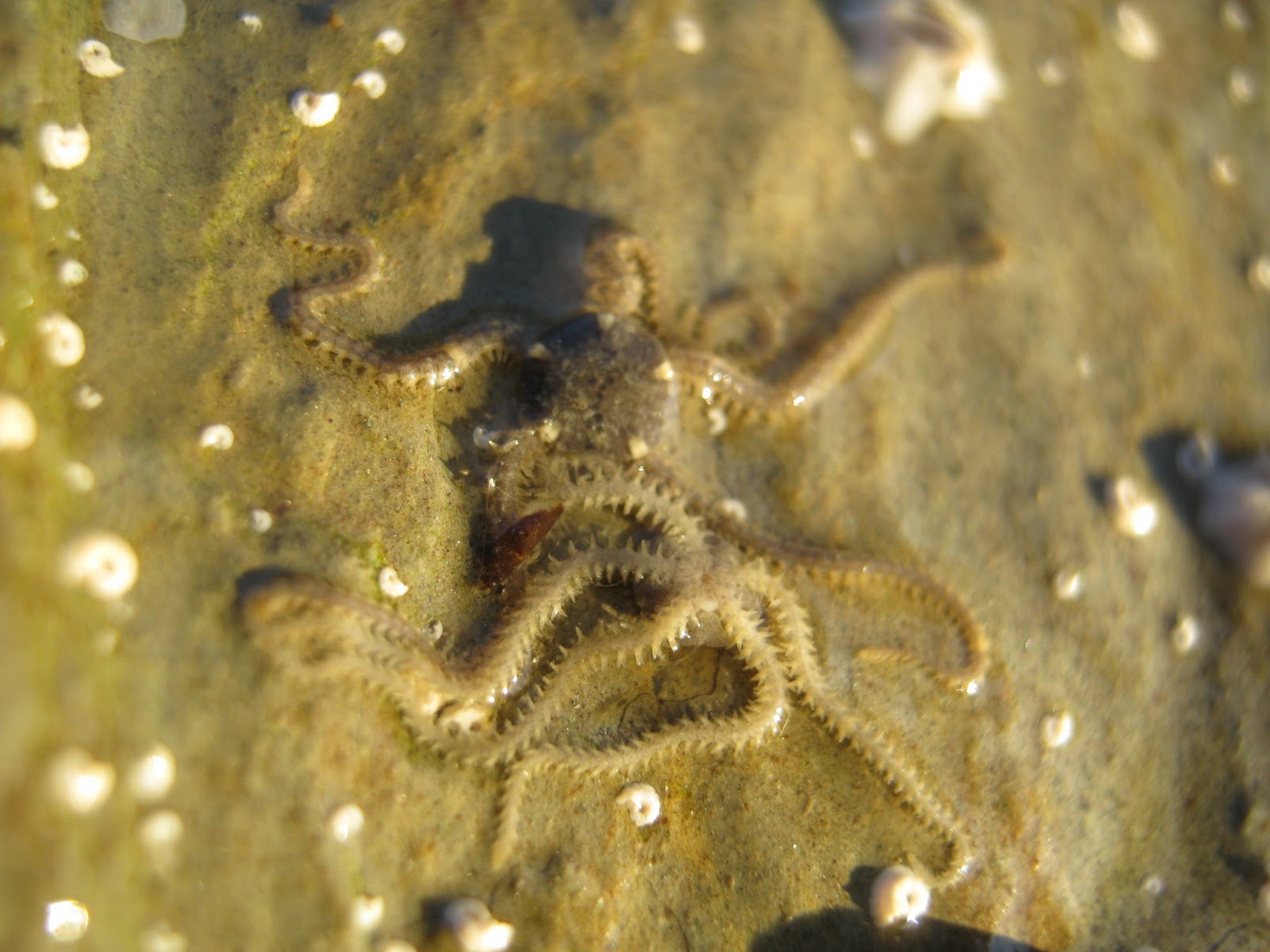
Two Small Common Brittle Stars, Ophiothrix fragilis
The Common Brittle Star (Ophiothrix fragilis) is a widespread invertebrate of European waters. It has a body comprising of a central, flattened disc from which five narrow arms radiate (1). Dense beds of O. fragilis are quite common in European waters, often of up to 2000 individuals m-2 (2). Their suspension feeding action means that they remove and recycle organic material in the water, and as such provide an important link between benthic and pelagic ecosystems (3).

References:
  1. Sterry, 2004 Collins Complete Guide to Irish Wildilfe p. 176
  2. Broom, 1975 Journal of the Marine Biological Association of the UK 55 pp. 191-197
  3. Allen, 1998 Marine Biology 132 pp. 383-390