Friday, December 3, 2010

The Brittle Star Link

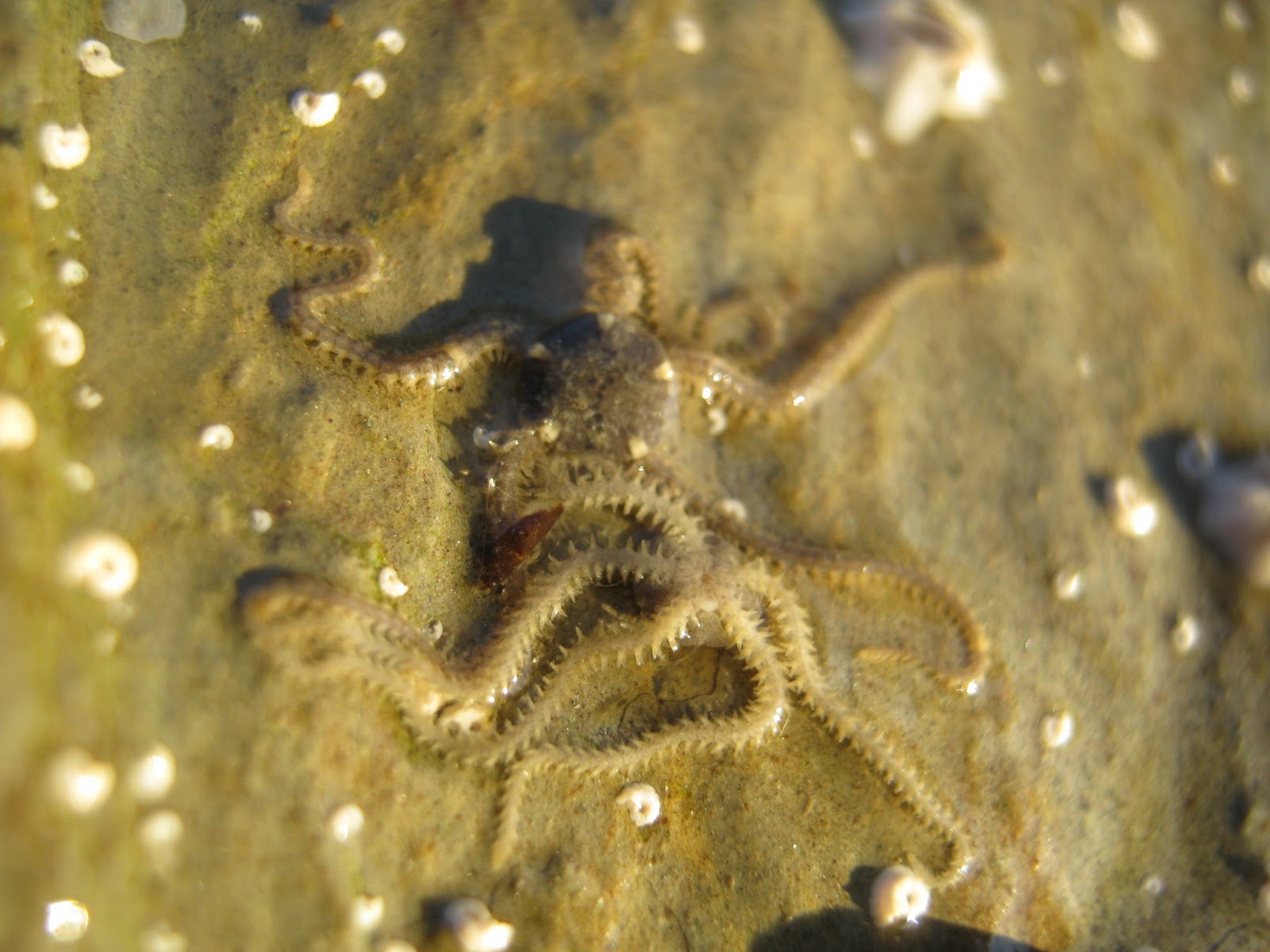
Two Small Common Brittle Stars, Ophiothrix fragilis
The Common Brittle Star (Ophiothrix fragilis) is a widespread invertebrate of European waters. It has a body comprising of a central, flattened disc from which five narrow arms radiate (1). Dense beds of O. fragilis are quite common in European waters, often of up to 2000 individuals m-2 (2). Their suspension feeding action means that they remove and recycle organic material in the water, and as such provide an important link between benthic and pelagic ecosystems (3).

References:
  1. Sterry, 2004 Collins Complete Guide to Irish Wildilfe p. 176
  2. Broom, 1975 Journal of the Marine Biological Association of the UK 55 pp. 191-197
  3. Allen, 1998 Marine Biology 132 pp. 383-390

Monday, November 22, 2010

Arabian Oryx

A guest post by Ken.

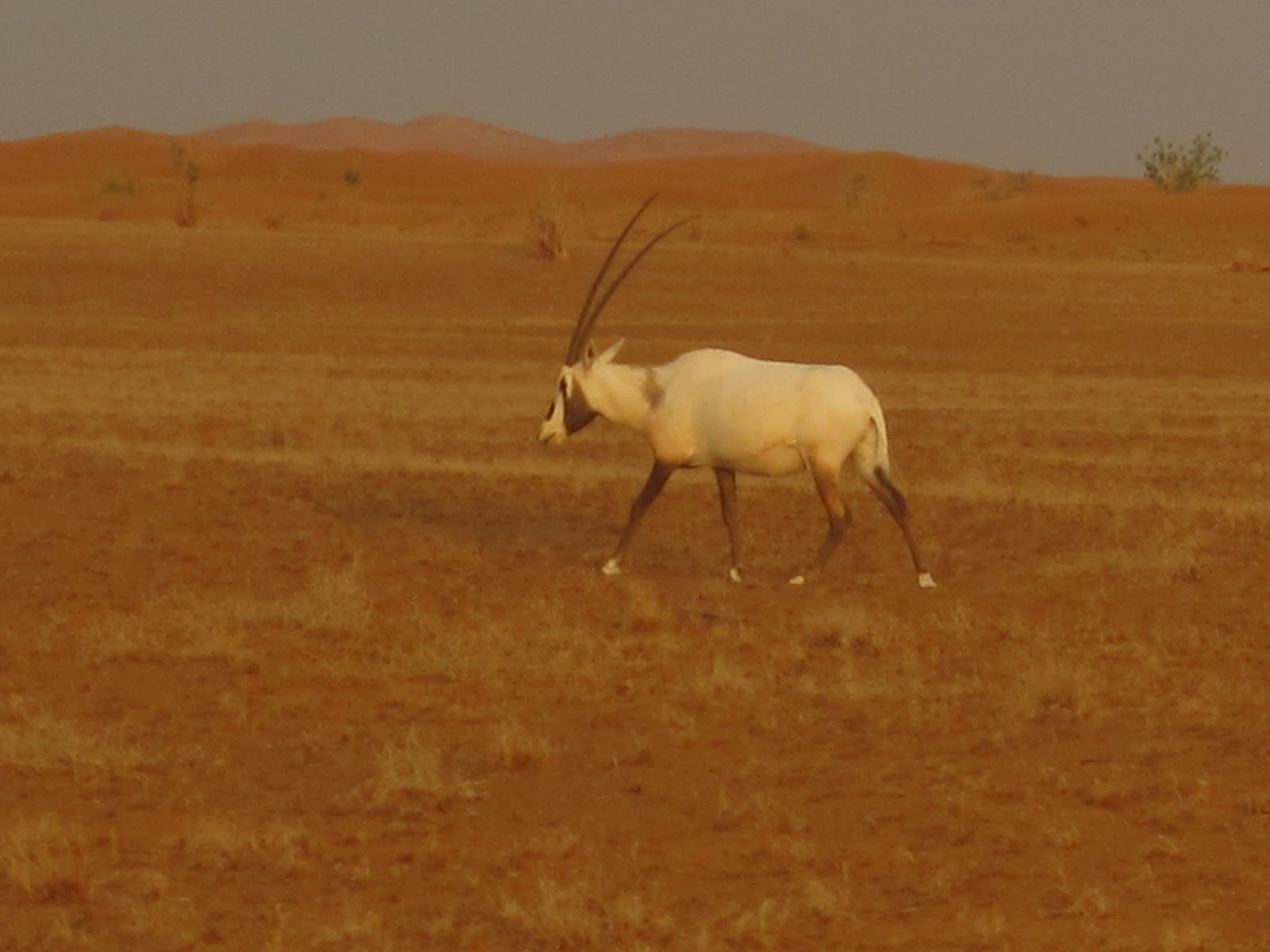
During a recent bout of 'dune-bashing' in the Dubai Desert Conservation Reserve, I came upon a herd of Arabian Oryxes (Oryx leucoryx). Our guide, a man from Burundi (where they have all the usual African wildlife except for elephants he informed me), who had been giving the safari for ten years was quick to spot them. He said this was a rare sight. The Dubai desert plains can reach temperatures of up to high 40's. However, by the time I was there in November it was down to low 30's. It had also just rained heavily, another unusual sight in the Emirate of Dubai in the U.A.E. This maybe why we were graced with a glimpse. I quickly grabbed my sister's camera to take a few pictures.
Dune Bashing
O. leucoryx are the most easterly-ranging oryxes and are native to Arabia and Iraq. They usually live in deserts, arid plains and rocky hill-sides. Both sexes have straight horns with the female's horns usually being longer and more slender. The mane extends from the shoulders and they possess a slightly tufted tail. The head and body are pale with definite markings of black or brown. They roam in herds of two to a dozen and are always alert and vigilant. If injured or confronted by their natural predators they attack with lowered heads with the horns pointed dangerously forward. They eat primarily grasses and shrubs using streams and waterholes as a source of water. However they can obtain water from desert fruit or succulent bulbs (1).
A herd of wild Arabian oryxes (Oryx leucoryx)
The species was eradicated entirely from the Arabian Peninsula by 1972 due to over-hunting and poaching. Prior to the extirpation, however, several captive breeding programs were started with the intention to reestablish them in their native habitats. Ismail et al. show that the frequency of reproductive activity was significantly related to daytime, temperature and radiation with significant reduction during a drought period. Also extreme climatic events, suitability of habitat aswell as carry capacity must be taken into account when managing introduced populations of desert ungulates in fenced protected areas (2).
Check out my white socks!!!
And then they were gone. Although we slowed down so as not to frighten them too much, we eventually went our separate ways. And for now, at least, we can be certain that the Arabian Oryx is alive and well.

References:
  1. Biological Conservation, Volume 1, Issue 2, January 1969, Page 129
  2. K. Ismail, K. Kamal, M. Plath, T. Wronski, Effects of an exceptional drought on daily activity patterns, reproductive behaviour, and reproductive success of reintroduced Arabian oryx (Oryx leucoryx), Journal of Arid Environments, In Press, Corrected Proof, Available online 29 October 2010
Thursday, November 18, 2010

Hermit Crabs Prefer Winkle Shells

Pagurus bernhardus, the Common Hermit Crab
Pagurus bernhardus, the Common Hermit Crab, is a scavenger of sheltered shores, and is the most common hermit crab in Irish waters. It can often be spotted in rock pools, seen as a seashell with legs scurrying into corners. It has, along with all the hermit crabs, the last thoracic plate on the ventral side free of the carapace (1) and because of this, P. bernhardus lives inside the empty shells of molluscs, exchanging the shells for larger ones as the animal grows. The fifth pair of walking legs are also reduced to allow it to fit into the shell which also allows the animal to grip the inside of the shell (2) and the right handed pincer is larger than the left to block the shell entrance when the crab retreats inside (3). It has been suggested that hermit crabs originated from crevice dwlling ancestors, which had progressively lost their abdominal calcification, and took to using empty mollusc shells due to their mobility (4).
Pagurus bernhardus emerging from Edible Periwinkle (Littorina littorea) shell
Young P. bernhardus individuals have a marked preference for winkle shells, both Littorina littorea (Edible Periwinkle) (5) and L. obtusata (Flat Perieinkle) (6) over Gibbula spp. (Whelk) shells. This preference may be due to a number of factors, such as greater ease of locomotion and ease of manipulation during mating, and does have an effect on the overall performance of an individual. A 1995 survey of female P. bernhardus individuals showed that those living in the preferred shells produced eggs earlier in the season, produced more eggs in the first brood, and produced a second brood more often than did females in the less preferred shells (6). However it was unclear whether this reflected a reduced capacity for mating or if competition for the best shells resulted in low quality crabs occupying the less preferred ones.
Pagurus bernhardus, the Common Hermit Crab. Note the difference in size of the pincers

References

  1. Lancaster, 1988 Field Studies 7 pp. 189-238
  2. Challinor et al., 1999 A Beginner's Guide to Ireland's Seashore p. 142
  3. Sterry, 2004 Collins Complete Guide to Irish Wildilfe p. 168
  4. McLaughlin, 1983 Journal of Crustacean Biology 3 608-621
  5. Elwood et al., 1979 Animal Behaviour 27 pp. 940-946
  6. Elwood et al., 1995 Marine Biology 123 pp. 431-434

Tuesday, November 16, 2010

A Delicate Beauty

Tunbridge Filmy Fern (Hymenophyllum tunbrigense)
Hiding among the moss, blending in to such an extent that it can be easily mistaken for one of them, the Tunbridge Filmy Fern (Hymenophyllum tunbrigense) has a diaphanous magnificence. It grows in shady habitats, forming a mat when growing, either vertically or at an incline, against rocks or tree trunks by streams or under dripping water (1). It has numerous, overlapping leaves which have multiple pinnae. These arise from slender rhizomes which are much-branched (2). Tunbridge Filmy Fern is very similar in appearance to Wilson's Filmy Fern (H. wilsonii), but both are found at different elevations: Wilson'd Filmy Fern tends to be found on mountain tops, while Tunbridge Filmy Fern inhabits lowland or slightly elevated wooded glens (3). This difference in locality is due in part to the different light requirements for the two species, with Tunbridge Filmy Fern having a lower light requirement than Wilson's Filmy Fern (4). Tunbridge Filmy Ferns is a very long lived species, with some colonies being 200 years old.
Tunbridge Filmy Fern (Hymenophyllum tunbrigense)
References
  1. Phillips, 1980 Grasses, Ferns, Mosses and Lichens of Great Britain and Ireland p. 108
  2. Richards and Evans, 1958 Journal of Ecology p. 245
  3. O'Mahony, 2009 Wildflowers of Cork City and County p. 323
  4. Proctor , 2003 Annals of Botany 91 pp. 717-727

Thursday, November 11, 2010

Brown Seaweeds of Kelp Beds

Laminaria hyperborea

Holdfast of Laminaria hyperborea
Laminaria digitata
Laminaria digitata

Holdfast of Laminaria digitata
Saccharina latissima

Frond of Saccharina latissima

Holdfast of Saccharina latissima

Saccorhiza polyschides

Saccorhiza polyschides

Holdfast of Saccorhiza polyschides

Flight of the Butterfly

Red Admiral, Vanessa atlanta
One of the larger butterflies top be seen in Ireland, the Red Admiral (Vanessa atlanta) is a common sight of meadows, hedgerows and gardens with red bands and white spots contrasting boldly with its black upperwings (1). V. atlanta can be seen from May onwards in Ireland, with some individuals hibernating through the winter (2). Most, however, migrate from central and southern Europe to escape the summer droughts of these areas (3). Nettles (Urtica doica) are the food of choice of the larvae and these have begun to wither when migration begins. When the butterflies arrive in the north, there is a plentiful supply of food. Most adults will return south in late September to mid November when nettles are again in good supply.
Red Admiral, Vanessa atlanta
When returning south, V. atlanta engages in a high elevation return at a reported altitude of 2000 meters (3), riding on cool northerly winds. While flying it generates large forces that cannot be accounted for by conventional steady-state aerodynamics, as do all insects. Investigations into V. atlanta flight using wind tunnels and smoke-wire flow visualisations show that they use a variety of unconventional aerodynamic mechanisms to generate force, often different mechanisms in successive strokes (4)

References

  1. Sterry, 2004 Collins Complete Guide to the Irish Wildlife p. 104
  2. Chinery, 1987 Field Guide to the Wildlife of Britain and Europe p. 234
  3. Mikkola, 2003 European Journal of Entomology 100 pp. 625-626
  4. Srygley and Thomas, 2002  Nature 420 pp. 660-664

Wednesday, November 10, 2010

Blennies Seek Out the Dark

The Blenny (or Shanny, Lipophyris pholis) is a very common fish of the the North East Atlantic from Norway to Mauritania and the Atlantic islands, with some records in the Western Mediterranean (1). It is particularly widespread on the Western coast of Ireland. Found among stones and seaweeds in rocky gullies on the lower shore, it often becomes trapped in rock pools at low tide where the specimen pictured was spotted. While this is a small (c. 4 cm) example of the species, they can reach 10 cm in size (2).
Blenny, Lipophyris pholis, in a rock pool

Blennies show a preference for rocky over sandy substrata from an early age (3). The reason for this is unclear, but in such environments, Blennies will immediately make for the first dark area as soon as possible. Dodd et al. (4) have shown that in an artificial novel environment, they will move towards a black screen, pressing themselves up against it. Once they have gained experience of this environment, they will us the positions of large objects around them to relocate a refuge.

References
  1. Steffani et al., 2006 Molecular Phylogenetics and Evolution 39 pp. 282–287
  2. Sterry, 2003 Collins Complete Guide to Irish Wildlife p. 102
  3. Almada and Faria, 2000 Journal of the Marine Biological Association of the UK 80 pp. 1143-1144
  4. Dodd et al., 2000 Behavioural Processes 49 pp. 69-75