Tuesday, November 9, 2010

Sponge Repair

The Breadcrumb Sponge, Halichondria panicea
Probably the most common sponge to be seen on Irish seashores is the Breadcrumb Sponge, Halichondria panicea. It can be seen on the lower shore, varying in colour from yellow to green, with crater like openings dotting the surface (1). These are the exhalent openings through which seawater passes.
The Breadcrumb Sponge, Halichondria panicea
H. panicea is predated by a number of organisms, generally molluscan (2). It is also prone to wave damage due to its frequent position on rock faces on the lower shore and these two destructive forces pose a real problem for the sponge. Yet it persists, often in large amounts. This is due to its incredible regenerative abilities. Simulation of feeding in H. panicea by creating grooves in the sponge resulted in high growth rates in these areas, with most of the damaged area being recovered within 4 weeks (3).

References 
  1. Challinor et al., 1999 A Beginner's Guide to Ireland's Seashore p. 71
  2.  Knowlton and Highsmith, 2000 Marine Ecology Progress Series 197 pp. 285-291
  3. Knowlton and Highsmith, 2005 Journal of Experimental Marine Biology and Ecology 327 pp. 36-46

Monday, November 8, 2010

Antimicrobial Synergism and the Spindle Tree

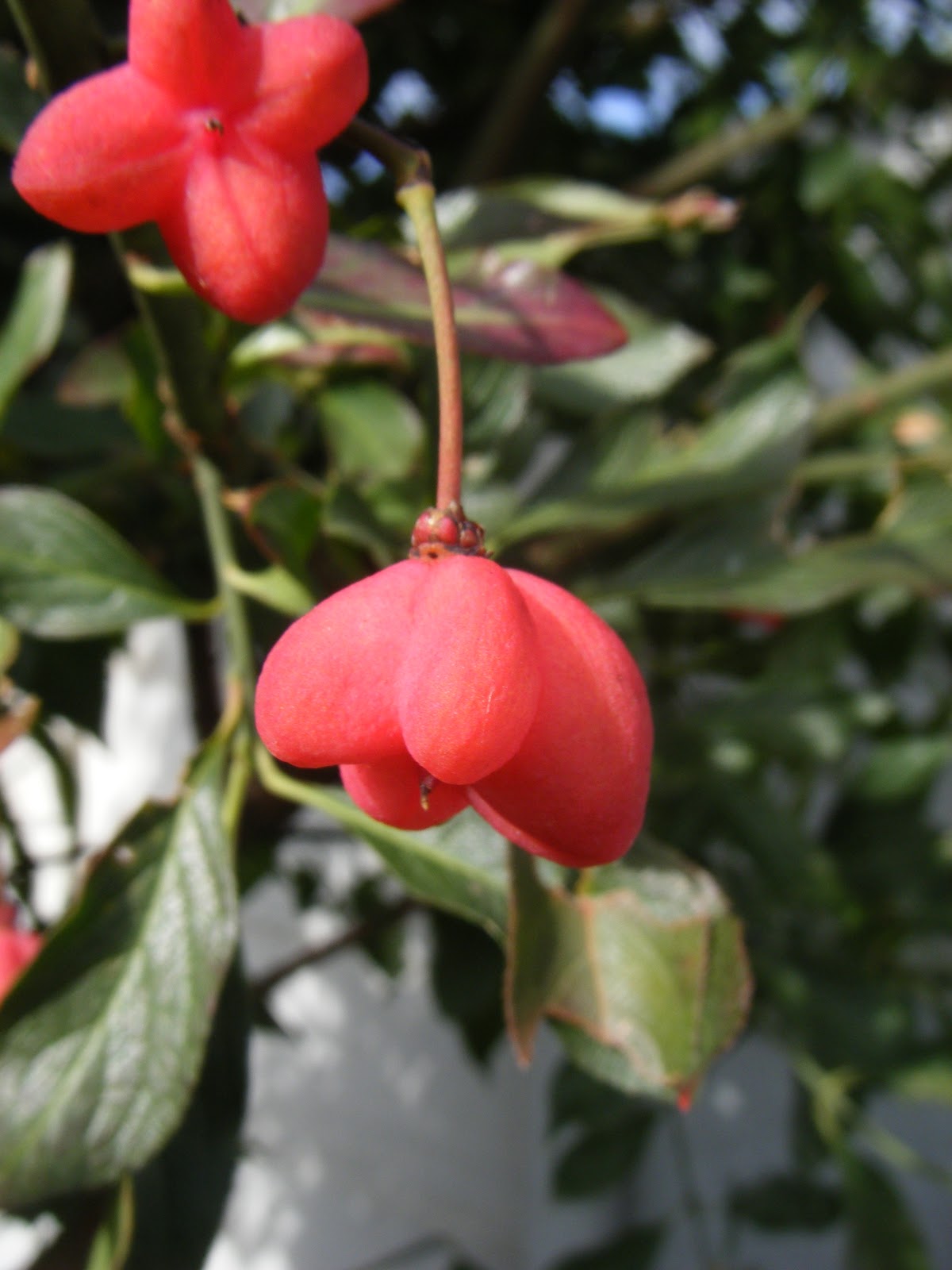
Fruit of Spindle Tree, Euonymus europaeus
Though the fine weather of the summer has given way to storm warnings and cold, dark mornings, its memory still lingers in the fruit of the Spindle Tree (Euonymus europaeus). This native shrub usually produces very distinctive, shocking pink, three to four lobed fruit from September to October (1) that is quickly eaten by blackbirds. This year, the summer has given a plentiful harvest of fruit that has until now meant many E. europaeus berries have gone untouched.
Spindle Tree, Euonymus europaeus
E. europaeus has proved to be quite useful: its hard timber was used to make skewers and spindles for spinning wool (hence the common name (1)). It has also been shown to produce secondary metabolites with remarkable antimicrobial abilities. Van den Bergh et al. (2) isolated a hevein-type antimicrobial peptide in 2002 from the bark of E. europaeus that show excellent antimicrobial activity against plant pathogenic fungi such as Fusarium oxysporum, Pythium ultimum and Rhizoctonia solani and Gram-positive bacteria such as Bacillus megaterium. This E. europaeus chitin-binding protein or Ee-CBP was also shown to be very stable as activity was not affected by boiling for ten minutes or prolonged storage.
Bark of Spindle Tree, Euonymus europaeus
A  further chitin binding protein was also isolated (3) that acted as a classical class I chitinase (Ee-chitinase) which was not as potent as the Ee-CBP. However, the Ee-CBP and Ee-chitinase displayed a pronounced synergistic effect in assays against fungal activity. These proteins have potential to be used in genetic engineering for biological control of plant diseases.

References
  1. Phillips, 1978 Wild Flowers of Britain pp. 58 and 172
  2. Van den Bergh et al., 2002 FEBS Letters 530 pp. 181-185
  3. Van den Bergh et al., 2004 Planta 219 pp. 221–232

Roman with the Fallow Deer

Fallow Deer, Dama dama
The Fallow Deer (Dama dama) is the most common deer in Ireland. It is not a native species, having been introduced by the Normans to the Royal Deer Forest in Glencree, Co. Wicklow in 1244 (1). The deer is originally from the Eastern Mediterranean, and has been transported by humans throughout Europe, Africa, America and Australasia (2). One of the earliest translocations has been traced to the Neolithic period when animals were introduced to Rhodes (3). Movement of the animals throughout Europe has been attributed to the Normans (4), but Sykes et al. (5) suggest that the Romans were also a force in distributing D. dama across Europe. Analysis of remains found in 2003 at a Roman settlement at Monkton on the Isle of Thanet, Kent in England showed that it was highly likely that herds of D. dama existed here during Roman times.

Fallow Deer, Dama dama
References
  1. Nolan and Walsh, 2005 Wild Deer Management in Ireland: Stalker Training Manual
  2. Chapman and Chapman, 1975 Fallow Deer: Their History, Distribution and Biology
  3. Masseti et al., 2006  Human Evolution 21 pp. 167–176
  4. Sykes, 2007 British Archaeological Report, International Series 1656
  5. Skyes et al., 2011 Journal of Archaeological Science 38 pp. 156-165

Thursday, November 4, 2010

The Ability of Nostoc commune to Resist Dessication

Nostoc commune
The cosmopolitan cyanobacteria Nostoc commune is found on all continents, in all conditions, from tropical rain forests to the poles (Whitton and Potts, 2000 Ecology of Cyanobacteria: their Diversity in Time and Space). It is a common pest of gardens, associated with areas of poor drainage and/or poor nutrients, often forming masses of gelatinous, globular, brown-green colonies. These are composed of filaments of cells surrounded by a sheath. In the past, these colonies were believed to have fallen from the sky and were referred to as, among other things, “Sternschnuppen” (shooting stars) (Potts, 1997 International journal of Systemic Bacteriology p. 584).
Nostoc commune in a dessicated state

N. commune shows a remarkable capacity to resist desiccation, being able to survive storage at -400 MPa (0% relative humidity) for centuries (Potts, 1994 Microbiology Reviews 58 pp. 755–805). Prior to rehydration, N. commune appears as a brittle crust which increase in size rapidly upon the addition of water.

This remarkable ability is due to the presence of a viscous extracellular polysaccharide that is excreted by the cells. This glycan consist of a 1-4-linked xylogalactoglucan backbone with D-ribofuranose and 3-O-[(R)-1-carboxyethyl]-D-glucuronic acid (nosturonic acid) pendant groups (Helm et al., 2000 Journal of Bacteriology 182 pp. 974-982). Prevention of dessication is achieved by a number of processes. The glycan inhibits fusion of membrane vesicels during dessication (Hill et al., 1997 Journal of Applied Phycology 9 pp. 237–248). It also provides a structural and/or molecular scaffold with rheological properties which can accommodate the rapid biophysical and physiological changes in the community upon rehydration and during recovery from desiccation. The glycan matrix contains both lipid- and watersoluble UV radiation-absorbing pigments which protect the cell from photodegradation (Hill et al., 1994 Protoplasma 182 pp. 126–148). Finally although epiphytes colonize the surfaces of N. commune colonies, there is no penetration of the glycan due in part to a silicon- and calcium-rich pellicle and inherent resistance of the glycan to enzymatic breakdown.

Production of such an extracellular polysaccharide as this by N. commune may explain why microfossils of cyanobacteria are preserved so well from more than 3.5 billion years ago (Schopf and Klein, 1992 The Proterozoic Biosphere p. 185–193).

Tuesday, November 2, 2010

Snuff Said

Candle Snuff Fungus, Xylaria hypoxylon
To be found throughout the year, Candle Snuff fungus (Xylaria hypoxylon) is most visible now as most ground cover in the deciduous woodlands it is associated with has died back for the winter. It is cylindrical to flattened in shape, branching into an antler formation. The upper stromal surface is white and powdery and becomes black tipped at maturity. The lower, sterile parts are black and downy (Jordan, 2004 The Encyclopedia of Fungi of Britain and Europe p. 78).
Candle Snuff Fungus, Xylaria hypoxylon

Carabid Controller

The carabid beetle, Pterostichus madidus is a very common ground beetle that although being mainly active at night, is often seen in the day time if disturbed from under stones of logs. It is readily identified by its shiny, black body, the fine grooves in its elytra and its typically reddish legs (Sterry, 2004 Collins Complete Guide to Irish Wildlife p. 146). P. madidus is sometimes called the strawberry beetle as it feeds on strawberries as well as other fruit, but it is mainly carnivorous (Chinery, 1997 Collins Gem Insects, p. 129).
Pterostichus madidus
Quantitative ELISA analysis of crop content of the beetle has shown that quite a large proportion of its diet has consists of molluscs (Symondson and Liddell, 1993 Bulletin of Entomological Research 83 pp. 641-647). This feeding habit was shown to posit P. madidus as a potential biological control agent for slugs and snails by a glasshouse experiment (Asteraki, 1993 Entomophaga 38 193-198). This demonstrated that it controlled slug (Deroceras reticulatum) populations in a grass/clover sward. However Mair and Port (2001, Agricultural and Forest Entomology 3 pp. 99-106) have shown that the original serological tests may have been misleading as they showed that dead slugs were consumed by P. madidus in preference to live ones in laboratory conditions. Live slugs that were killed and consumed were quite small (<0.11 g). Yet the use of P. madidus to control molluscan pests is still a viable alternative to chemical means, as long as it is combined with methods to control the larger individuals.

Monday, November 1, 2010

Ascent of the Ascidians

Star Ascidian, Botryllus schlosseri
Phylogenetics is slowly rewriting our ideas of relationships between many organisms. Take for example the Ascidians. These tunicates (urochordates) were beliveved to once be a sister group of the vertebrates, due in part to the presence of characteristics such as segmented muscle (Lemaire et al., 2008 Current Biology 18 R620–R631). The lancelets (cephalochordates) were assumed to be the most closely related to the vertebrates as there are overall morphological similarlties and an increased complexity between these two groups when compared to the seemingly simpler tunicates. However in 2006, Delusc et al. (Nature, 23 pp. 965-968) analysed data from the sequencing of the tunicate Oikipleura dioica genome and found that tunicates represent the closest living relatives of vertebrates. Indeed, Delusc suggested that the lancelets be grouped with the echinoderms rather than than the tunicates or vertebrates.
Star Ascidian, Botryllus schlosseri
Botryllus schlosseri (Star Ascidian) is a cosmopolitan, colonial ascidian that is found encrusting on rocks, shells and large brown seaweeds (Challinor et al., 2003 A Beginner's Guide to Ireland's Seashore p. 74). It has been used for over 50 years in the laboratory as a model system for the study of blastogenesis, colony fusion and regeneration (Manni et al., 2007 Developmental Dynamics 236 pp. 335-52). It forms free living, pelagic larvae by sexual reproduction that attach to a substrate and in turn reproduce asexually to form colonies of numerous genetically identical zooids. Individuals are arranged around a common cloak siphon, thus forming the “star” of the common name.