Friday, May 7, 2010

The Lesser Periwinkle

A guest post by Ken.

During a short walk in Knaresborough, in North Yorkshire, I discovered a wonderful looking plant. It was the Lesser Periwinkle (Vinca minor). This plant is a member of the periwinkle family Apocynaceae, which are creeping woody shrubs with opposite, evergreen, oval untoothed leaves and have corollas with 5 spreading lobes, twisted in bud. The other member of the family is the Greater Periwinkle (V. major) and although very similar to V. minor, the calyx-teeth on the Greater Periwinkle are hairy and the leaves are oval rather than lanceolate. (Rose, Francis et. al. The Wild Flower Key; Revised edition, 2006, p.352).


The Lesser Periwinkle - Vinca minor

The alkaloid vincamine from this Lesser Periwinkle is used in the production of the synthetic compound vinpocetine. This is a potent neuroprotective agent. It is used in neurological practice, particularly in cerebrovascular diseases such as ischemic stroke. The drugs main pharmacological and physiological actions are not fully understood. Recent studies have shown that Vinpocetine contributes to a regional redistribution of cerebral blood flow in such a way that relatively more blood reaches the brain structures which show a high uptake of radiolabelled vinpocetine. The chemical can also regionally modify the utilisation of glucose in the brain and this effect is more pronounced in the affected hemisphere. These effects of vinpocetine suggest that, through direct CNS effects, the drug can usefully contribute to the restoration of physiological conditions in stroke patients. (Geza Szilagyi, Zoltan Nagy, Laszlo Balkay, Istvan Boros, Miklos Emri, Szabolcs Lehel, Terez Marian, Tamas Molnar, Szabolcs Szakall, Lajos Tron, Daniel Bereczki, Laszlo Csiba, Istvan Fekete, Levente Kerenyi, Laszlo Galuska, Jozsef Varga, Peter Bonoczk, Adam Vas, Balazs Gulyas, Effects of vinpocetine on the redistribution of cerebral blood flow and glucose metabolism in chronic ischemic stroke patients: a PET study, Journal of the Neurological Sciences, Volumes 229-230, Vascular Dementia, 15 March 2005, Pages 275-284).

One did a spot of rowing that day too. Icelandic volcanic ash clouds prevented me from flying. Still, at least I got to see another beautiful plant.

Tuesday, April 27, 2010

The Grand Old Goose of York

A guest post by Ken.

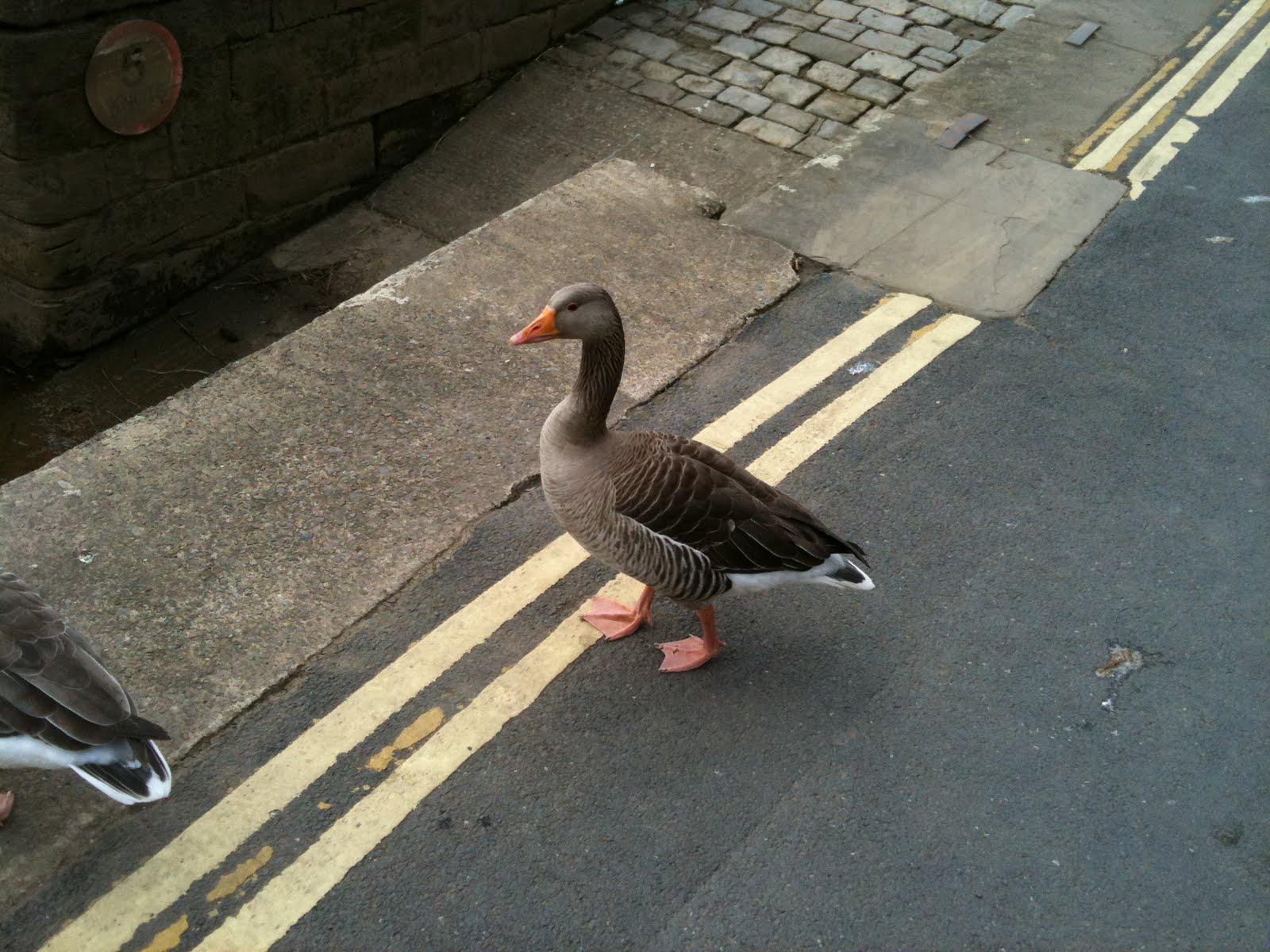
Whilst on a sojourn recently in Yorshire I took a trip to York only to come upon a goose. The greylag goose (Anser anser). I was walking along a canal with friends of mine and there it was. Later I saw two more along with eight offspring.


Greylag goose (Anser anser)

Greylag geese are monogamous, exist in a female-bonded social system, similar to primates, and their fledged offspring stay with them until the next breeding season. Dominance rank in flocks of geese is determined by the active social support family members or pair partners give to each other. Parents provide active assistance for their offspring in encounters with other members of the flock but females and juveniles of several species of geese involved in agonistic behaviour were more successful when a male partner or parent was present but did not actively interfere. If parents fail to produce young, subadults (a bird with some adult traits but not yet sexually mature) may rejoin them in summer after molting is completed and thus form a 'secondary family' and this may be seen as an alternative tactic for the subadult geese where they associate with former allies when no suitable mate is available. Scheiber et al. suggest that retaining a family unit might allow both the parents and the offspring to preserve a high social status and also enjoy the benefits of a social alliance such as the males winning agonistic interactions and the females having a decreased level of CORT (lower stress levels). [Isabella B.R. Scheiber, Kurt Kotrschal, Brigitte M. Wei[ss], Benefits of family reunions: Social support in secondary greylag goose families, Hormones and Behavior, Volume 55, Issue 1, January 2009, Pages 133-138].

Greylag goose family

Whilst taking the above picture the nearest adult goose hissed quite loudly at me. I only wanted to say 'Hello'. Although greylag geese can be hand-raised and see humans as allies in their agonistic interactions this was certainly not the case here. I was not part of their family.

I walked on.

Monday, April 26, 2010

A Pretty Pest

Common Toadflax, Linaria vulgaris

Rare in the rest of Ireland, the pretty Common Toadflax (Linaria vulgaris) is frequently spotted in the South to Southeast of the country. Producing its yellow flowers from June to October, it can be found on roadsides, waste ground, grass banks and cultivated fields growing to a height of 60 cm. Its status as an Irish native is questionable, however it does help to support long-tongued pollinators such as Bombus pascuorum and B. hortorum by the provision of valuable nectar (Corbet et al., 2001 Annals of Botany 87 pp. 219-232). Taxonomically, L. vulgaris was traditionally placed in the family Scrophulariaceae. Recent phylogenetic analysis of DNA regions from members of the family now places the genus Lniaria within the Plantaginaceae (Albach et al., 2005 American Journal of Botany 92 pp. 297–315).

L. vulgaris is used in traditional medicine as a laxative, as well as for the treatment of inflammation of the bladder, skin rashes and haemorrhoids. Its perceived activity is due to the presence of iridoid glucosides (such as antirrinoside and procumbide) in the stem, leaves and roots of the plant (Ilieva et al., 1992 Phytochemistry 31 pp. 1040-1041).

Unfortunately, what is seen as an attractive margin wildflower by some, has become a pest to others. L. vulgaris was introduced to the USA as an ornamental garden plant, but soon escaped into the wild and was recognized as a major agricultural weed in 1758 by the botanist John Bartram (Mack, 2003 Annals of the Missouri Botanical Garden 90, 77–90). Bartram stated that “neither the spade, plough nor hoe can eradicate it, when it is spread to a pasture”, undoubtedly due to the extensive creeping root system of the plant. The problem persist today, however the introduction of the weevil Mecinus janthinus as a biological control agent into both the USA and Canada has helped to control L. vulgaris populations (McClay and Hughes, 2007 Biological Control 40 pp. 405-410).

An Orange Demiosponge, Hymeniacidon perleve

Hymenacidon perleve

Hymenacidon perleve is a Demiosponge of the family Halicondridae commonly seen in the intertidal areas of Irish shores. As a species, it has been recorded in the Atlantic, Pacific and Mediterranean as well as the Southern coast of Africa. It is a very conspicuous sponge, being a vibrant orange colour.

It has recently been mined as a source of new actinobacteria, which have the potential to provide novel bioactive compounds, such as antibiotics. Actinobacteria produce over half of the bioactive compounds in the Antibiotic Literature Database (Lazzarini et al., 2001 Antonie Van Leeuwenhoek 79 pp. 399-405). Zhang et al. (2006, Antonie van Leeuwenhoek 90 pp 159–169) report on the isolation of 106 actinobacteria from H. perleve from the China Sea. 74% of the isolates were Streptomyces spp. and three strains isolated are candidates for new species.

H. perleve has also shown remarkable ability to remove pathogenic bacteria from ambient water. Sponges filter the water passing through them and feed off the subsequent filtrate. Due to this feeding mechanism, sponges have shown a high capacity to reduce microbial pollution associated with faecal contamination (Claus et al., 1967 Nature 216 pp. 712–714), a common problem in aquaculture systems. H. perleve has been used to control bacterial levels in turbot water systems (Zhang et al., 2008 Journal of Biotechnology, 136, pp. S685). Fu et al. (2008, Journal of Biotechnology pp. S548–S557) has even shown with work on a non infectious Escherichia coli and infectious Vibrio spp. that infectious bacteria can be discriminated by 14-3-3 gene expression of H. perleve.

Hymeniacidon perleve

Friday, April 23, 2010

Protection from Nematodes

Nematode
Plant parasitic nematodes are major agricultural pest. For example, potato cyst nematodes (Globodera pallida and Globodera rostochiensis) alone are estimated to cause €350 million worth of losses annually in the EU alone. The use of fumigants (such as methyl bromide) to control nematode numbers has been curtailed due to public health concerns.

A very successful alternative to the use of such nematicides is the application of organic soil amendments to suppress nematode numbers. Examples of these organic soil amendments include plant preparations of Neem (Azadirachta indica) and Asteracea, organic manure and chitinaceous materials. In a recent study (Oka, 2010 Applied Soil Ecology 44 pp. 101–115) it was shown that, while interactions between organisms in the rhizosphere are quite complex, possible mechanisms such as release of nematicidal compounds from soil amendments, generation of such compounds during degradation and enhancement of antagonistic mico-organisms in the soil among others all combined to reduce nematode numbers.

Nematode

"Bright as the sun himself, 'tis out again!"

( from Wordsworth's "A Lesson")

Lesser Celandine (Ranunculus ficaria)

Whether it be nestled in a gap in stone work, adding colour to roadside ditches or blanketing forest floors, the Lesser Celandine (Ranunculus ficaria) is in its prime at the moment. A relative of the buttercup, it is unrelated to its name sake the Greater Celandine (a member of the poppy family). In the past, it was used as a treatment for piles, as described by Nicholas Culpeper in his Complete Herball (c. 1653):

"The leaves are antiscorbutic and the root reckoned a specific if beat into cataplasms and applied to the piles."

This earned the plant the name Pilewort, its name derived from the shape of the root. Its medicinal properties were discredited about fifty years later by Lindley who stated:

"Confident as are these assertions (those of Culpeper and others), yet the use of the plant is all but discontinued in the present day, medical practitioners properly looking for sounder principles than those derived from the doctrine of similitudes."

It was however still being advocated as a cure for piles in 1901 (Birmingham Medical Review, May 1901), but consumption in herbal remedy has been shown to result in necrotizing hepatitis (Strahl et al., 1998 Deutsche medizinische Wochenschrift 123 pp. 1410–4).

The classification of R. ficaria as such is in question, as several authorities consider it to be a genus of its own, Ficaria (Hörandl et al., 2005 Molecular Phylogenetics and Evolution 36 pp. 305-327).

Lesser Celandine (Ranunculus ficaria)

Monday, April 19, 2010

Seashore Polychaetes

Polychaetes play an important role in the functioning of many marine communities. This is due to a number of factors, such as their proliferation within certain habitats (such as benthic regions) and the diversity of their feeding modes. (Giangrande et al., 2005 Marine Pollution Bulletin 50 pp. 1153–1162). These range from surface deposit, suspension, mud swallowing, carnivory and herbivory to in a few species even parasitism.

Many burrow into the sediment both for protection against predation and also in search of food, and others actively swallow mud and deposited particulate matter in order to obtain their nutrition. Others are tubiculous and some of these species are highly gregarious (Hutchings, 1998 Biodiversity and Conservation 7 pp. 1133-1145).

Below are some common polychaete species to be found on Irish seashores.

Ragworm, Nereis diversicolor

Sand mason, Lanice conchilega

Honeycomb worm, Sabellaria alveolata

Keel worm, Pomatoceros triqueter