Wednesday, March 2, 2022

Unarmed by an Unarmed Stick Insect

Unarmed Stick Insect, Acanthoxyla inermis

The routes of introduction of non-native species into the island of Ireland are many, with the vast majority of those in the past 200 years being mediated by human activities. Many have been deliberate, with the species' adaptability to Irish conditions often leading to their proliferation, such as the catastrophic establishments of the invasive plants Rhododendron ponticum, Japanese Knotweed (Reynoutria japonica) and Winter Heliotrope (Petasites fragrans). Other instances have been accidental, and the happenstance of their presence have been as surprising as the species themselves.

One such example is the Unarmed Stick Insect, Acanthoxyla inermis. While the order of stick insects is distributed worldwide, Europe has only 17 species of native stick insects, with none being present on the island of Ireland. That is, however until late in the 19th century when Samuel Thomas Heard began to lay out his garden in Rossdohan Island in Kenmare, Co. Kerry.

Born in Cork, Samuel was an Indian Army Surgeon-Major until his retirement, when he bought the island of Rossdohan in Kenmare Bay in 1873. He proceeded to turn this uninhabited island of closely cropped vegetation into an exotic garden. His interest in gardening began in his youth, with many collections begin amassed in places such as Fota, Castlemartyr and Doneraile near his family seat at Ballintober, near Kinsale Co. Cork. This was further fuelled in Paris, a city he spent some time in upon graduating in medicine. There, the experiments in bedding out subtropical plants in the city's parks by Jean-Pierre Barillet-Deschamps were causing a stir worldwide. During his time in India, Samuel also became familiar with the Madras Horticultural Gardens. However probably his greatest influence when it came to laying out his garden in Rossdohan was his wife Kate Bradley, whom he married in 1862. Kate was from New South Wales in Australia and this inspired the import of many Australasian florae. It was the importation of plants and soil from New Zealand that is linked with the establishment in the area of the Unarmed Stick Insect, A. inermis. This  the source of which was Treseders Nursery in Truro, England. James Treseder took over the running of the nursery in 1820 and quickly developed the business. His sons all unsuccessfully tried their luck in the Australian gold fields but soon gave this up to run a successful nursery in Sydney. James' son John began the export to Europe of plants from Australia, New Zealand and Tasmania that he, correctly, though would be hardy enough to withstand the different climate. 

A. inermis, along with many other species of Phantasmids, reproduces parthenogenetically with males being virtually non-existent in established colonies. Several hundred eggs are laid by females in summer and early autumn so plant and soil material containing these can readily establish a new colony if transported elsewhere. The adults are polyphagious and slow moving with therefore little inclination to move elsewhere which means that colonies tend to be localised. This is very much the case with the population in Ireland, which is restricted to pockets around Kenmare. These areas are either associated with materials source directly from New Zealand (such as the colony in Derreen Gardens) or with the taking of material from Rossdohan and Derreen: the house at Rossdohan was burned down in 1923 and the estate all but abandoned for a period after Irish independence, leading to plants being taken from there by locals. A. inermis is now established at a garden centre in Kenmare, increasing the likelihood that its range will be extended further as material is disseminated from there.

While I was aware of its presence in the Kenmare area, it did come as a pleasant shock for me to find an individual in a suburban garden in Cork City. On the 16th of March, 2021, I found a juvenile wandering about some potted strawberry plants near some brambles in my back garden. The size of the individual and the time of the sighting indicates that it had hatched close-by, most likely from material source from Kenmare. The garden in question is closely bordered by a number of others all of which share the same bramble hedges. 
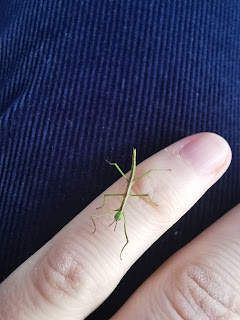
Juvenile Unarmed Stick Insect seen in Cork City

A. inermis grows to 90-125mm in length making them easily the largest insects on the island of Ireland. The body is smooth, although a few small tubercles may be present. The cerci are rounded. Body colour varies from green to brown, with brown specimens ranging from yellow to almost black. They feed on various members of the Rosaceae family, of which at least two were present near where this juvenile individual was found. It displayed a trait for which the A. inermis is well known, namely swaying from side to side as it moved. This is thought to aid camouflage by coping the movement of foliage in the wind.

References:

Lee, M. (2006) The Stick-insects of Great Britain, Ireland and the Channel Isles. Phasmid Study Group Newsletter 107: 20‒27
Lee, M. (2007) The Naturalised Stick-insects in South-west England. Atropos 32: 31-37
Malins, E. and Bowe, P. (1980) Irish Gardens and Demesnes from 1830 Barrie & Jenkins

Monday, April 27, 2020

Moth Eared

As the summer is about to begin, one of the large lepidoperan larvae currently visible is that of the Lesser Yellow Underwing Moth, Noctua comes. These larvae have emerged from an overwintering period and will restart feeding on the wide variety of plants that are typically consumed by this polyphagous species. Adults emerge from July to mid autumn from pupation in the soil, in an earthen chamber. While generally nocturnal, the larva can be seen in suburban gardens due to their varied diet which includes weeds and commercial bedding plants.
Lesser Yellow Underwing, Noctua comes, larva

The adults get their name from their orange-yellow hind wings that re generally not visible when at rest. While it is widely distributed throughout Europe, it is also established in North America where it was first recorded in 1984. Since then, it has proved to be a pest of grapes and tobacco which the larvae feed on to often quite damaging result.
As a night flying moth, N. comes is a major component of the diet of the European bat fauna. Hunting by echo location, the bats obviously emit sounds that the insects either cannot detect or do not respond to. However, often bats are ringed as part of conservation methods and sometimes there may be two rings close to each other. When these rings touch in flight a sound is created which alerts the moth, actuating evasive manoeuvers.

References:
Arlettaz et al., Animal Behaviour 57 1999 pp. 829-835
Alford, Pests of Fruit Crops: A Color Handbook 2007 pp. 369-370
Copley and Cannings, Journal of the Entomological Society of British Ccolumbia 102 2005 pp. 83-84

Thursday, January 7, 2016

The First Irish Trees

The wettest winter on record has finally brought us a cold snap. Temperatures that were touching the mid-teens have finally reverted to the winter norm and started to approach zero, bringing with them the long missed pleasure of the crisp, dazzlingly bright morning. Blue skies frame naked trees, an architecture that is all too absent from the Irish landscape. Despite having a reputation for being a verdant land, Ireland has long had the lowest area of forestry in the EU. Only 10.5% of the country is covered in forest (1). And while this is estimated to be at its highest level in 350 years (in 1928 the percentage cover was a measly 1.2%), more than three quarters of this are non-native coniferous plantations. The methods of cultivation of these forests, namely close and intensive planting which discourages lateral branching to maintain the bulk of the timber in one solid piece, renders such forests as areas of monoculture (predominantly Sitka Spruce, Picea sitchensis (1)) with a very low level of biodiversity. What we would refer to as native woodlands account for only a small fraction of Irish forests, but even calling them native is rather misleading as many of these are also themselves deliberately planted, such as Powerscourt estate in Co. Wicklow which dates to the first half of the 18th century (2). In truth, even trees in Ireland unmolested by humankind can only date from the after the most recent global glaciation period, when the vast majority of the island of Ireland was covered in ice.

Yet the history of Irish trees does extend back beyond the ice age, back into the mists of the Devonian period, some 350 million years ago when Ireland, as we know it now, was to be found near the equator. The present Irish landmass which had been previously divided by an ocean, now began to develop small lakes (3). These were surrounded by what many people believed to be the first tree, Archaeopteris, specifically Archaeopteris hibernica. Paleobotanical evidence points to plant species prior to this as tending to be ground covering. This was also thought of A. hibernica when it was first discovered, as the leaf like fronds were described separate to its woody trunk (called Callixylon) (4). This Callixylon could grow to impressive sizes, with fossils one meter in diameter and ten meters in length often being unearthed. Yet it was incorrectly identified as a Late Devonian conifer in when described in 1911. It took nearly 50 years for the link between Callixylon and Archaeopteris to be made. A chance discovery of a section of Archeaopteris with parts of the woody stem attached by Charles Beck allowed both Archaeopteris to be given the title of tree and the establishment of the extinct group of plants the progymnosperms (4). He was able to section an immaculately preserved sample and show that the attached wood was indeed Callixylon.

Archaeopteris hibernica fossil

Archaeopteris plants were non-seed bearing, producing spores much like modern day ferns on fronds that were arranged on branches. These extruded horizontally and in a helical pattern from a single trunk (5). Branching patterns were quite complex and longer living in comparison to other plants at the time allowed Archaeopteris to occupy more space, more efficiently. Indeed, it shares many of these features phylogenetically with modern seed plants (5). Its success was such that it was the pre-eminent vegetation of forests in the Late Devonian period though to the Mississippian.

Recreation of Archaeopteris hibernica

In old Devonian Ireland, A. hibernica was dominant. Wonderfully preserved examples of the fronds have been recovered from the Devonian-Carboniferous Kiltorcan Formation in Co. Kilkenny. Study of this area reveals a swamp like environment, with meandering streams feeding into pools surrounded by dense growth of A. hibernica (6).

References:
  1. Teagasc.,2014. Irish Forests -  Annual Statistics. http://www.teagasc.ie/forestry/docs/stats/Ireland%20Forests%20-%20Annual%20Statistics%20Report%20-%20issue%202014.pdf
  2. Pilcher and Hall, 2004. Flora Hibernica. Collins Press, Cork.
  3. Clayton et al. 1979. Journal of Earth Sciences. Vol. 2, pp. 161-183.
  4. Bora, 2010. Principles of Paleobotany. Mittal Publications.
  5. Meyer-Berthaud et al. 1999. Nature 398 pp. 700-701.
  6. Jarvis, 2000. Geological Society, London, Special Publications 180 pp. 333-341.

Tuesday, February 10, 2015

A Barrel of Pain

A common jellyfish found off the Irish coast, the Barrel Jellyfish, Rhizostoma pulmo, has quite an extensive range. It is distributed in the Irish Sea, the Bay of Biscay, the North Sea, the Black Sea and is found extensively throughout the Mediterranean, so much so that it commercially fished (albeit on a small scale) off the coast of Turkey (1). It has even been found off the coast of Pakistan, where a record again associated with commercial fishing of the jellyfish was reported in 2007 (2). It is quite a striking animal, with a robust appearance and an ethereal, blushed mauve coloration. Despite their their relatively large size (up to 60 cm in diameter), and possibly due to an underreporting of cases, it was assumed for many years that this species was harmless to humans (3). However, this is no longer the case (4).
 
Barrel Jellyfish, Rhizostoma pulmo
 
R. pulmo, like all jellyfish, is contradictory animal being as it is a relatively simple organism with quite a complex life cycle. This begins with the production of pelagic planulae by sexually mature adult that settle as polyps on hard substrates on the sea bed. These then metamorphose into strobilae, which reproduce asexually to form 8-rayed ephyrae. Up to eight of these may be produced per strobila. These detach to roam the pelagic zone where they mature into the adult medusae (5).
 
Barrel Jellyfish, Rhizostoma pulmo
 
Adults produce Rhizolysin, a cytolysin, from their nematocysts for subduing prey. This has cytotoxic, hemolytic and clastogenic activity against human cells, which leads to irritation and the production of lesions upon contact with the skin (4, 6). Such lesions last for a few hours, but the subsequent pain can last for a period of days, causing considerable discomfort.


References:
  1. Omori & Nakano, 2001. Hydrobiologia 451 pp. 19–26.
  2. Muhammed & Sultana, 2007. JMBA2 Biodiversity Records (Published on-line) pp. 1–3.
  3. Addad et al, 2011. Marine Drugs 9 pp. 967-983.
  4. Kokelj & Plozzer, 2002. Contact Dermatitis 46 pp. 179-180.
  5. Fuentes et al, 2011. Marine Biology 158 pp. 2247-2266.
  6. Allavenaa et al, 1998. Toxicon 36 pp. 933–936.

Wednesday, February 13, 2013

A Personable Little Bug

Firebug, Pyrrhocoris apterus
As I progress through life, my opinions and outlook has changed, in a way that I would like to think is more mature. One thing that has not changed about me though is how I tend to be led by my stomach. When I'm hungry I need to eat. Otherwise I get irritable and withdrawn. People often mistake it for some deep troubles within me, but its just a primal need to fill my belly. However I have learned to deal with it though in the simple possible way: regular eating. And sometimes the joys are not only culinary. Recently hunger grabbed me in Cork city and I made my way into the nearest cafe, a wonderful vegan eaterie (I'm an omnivarian, I'll eat anything at all, and don't mind if there is no meat with my meal as many carnivores often do). While tucking into my felafel and salad (which was smashing, if you were wondering), my eye was caught by something small and red on the Crassula plant that was in front of me. I was a Firebug (Pyrrhocoris apterus), a species that if not native to Ireland and a species that, as far as I can ascertain, has not been reported here before. The mature adult had been there at least one week, according to the staff, and may have arrived in one of the many deliveries of vegetables that they receive every week from continental Europe where P. apterus has its base. A flightless bug, it feeds on Lime trees and tree-mallows, and is most associated with its swarming behaviour whereby numerous individuals clamour together. Its common name, Firebug comes from its wonderful crimson colour that contrast wonderfully with the black markings on its abdomen creating an almost face-like effect.

As with all insects, P. apterus goes through a series of ecdyses through out its life, five in all from hatching to adulthood. Interestingly it has been shown that at different stages of moult, individuals show distinctly different personalities. Larvae differed from adults in general in that they were bolder, explored their environment more thoroughly and seemed to be more active before final ecdysis (1). This raises the intriguing concept of personality differences between individual organisms as inherited traits. In an environment, it is argued, if fitness payoffs are dependent on an organisms behavioural history and the frequencies of competing strategies then personality differences can be selected for (2). It certainly is an interesting idea and is supported by evidence from diverse sources as lab rats, where heavier newborns are braver and more explorative (3), field crickets, where personality changes at maturity (4), and squid, where size determines personality. How exactly the behavioural changes take place in P. apterus is not know, but it may be due to hormonal reorganisation.
 
So perhaps my apparent grouchiness due to lack of food is just my inheritance...

References:
  1. Gyuris et al., 2012. Animal Behaviour 84 pp. 103-109
  2. Dall et al., 2004. Ecology letters 7 pp. 734-739
  3. Rödel and Meyer 2011. Developmental Psychobiology 53 pp. 601-613
  4. Niemelä at al., 2011. Functional Ecology 26 pp. 450-456
  5. Sinn and Moltschaniwskyj, 2005. Journal of Comparative Psychology 119 pp. 99-110


Thursday, December 27, 2012

A Mayfly in December

Mayfly
It has been a a mild winter here in Ireland, especially considering the arctic conditions of two and three years ago. It is therefore not unusual to see a few strange phenological events occurring, such as plants in full flower and moths on the wing. One of the oddest, yet most delightful that I have seen recently is most certainly an adult mayfly, on the wing, not eleven days ago some 17 km from Cork city. It was odd because, as the name suggests, mayflies tend to emerge around May. Yet the emergence period for some species can from March to October. Still, seeing one a little over a week from Christmas was a little peculiar.

This sighting is also of interest as it brings to mind the recently published Red List of Irish Ephemoptera (1), detailing a check-list of the Irish species and their conservation status. Ireland is home to 33 species of mayfly, quite a low number in comparison to that of mainland Europe (350 species, (2)). However, even this relatively low number of species contributes greatly to their associated aquatic habitats. Mayflies spend the majority of their life in nymphal form (in some cases up to three years), and the feeding of these nymphs contributes greatly to the cycling and availability of nutrients in aquatic habitats (3). Such feeding can also greatly contribute to the cleansing of water systems and help maintain their integrity. On emergence from the nymphal stage the mayfly, uniquely in the insect world, passes through two terrestrail adult stages: the winged subimago and the winged and sexually mature imago. The life of these two stages is quite short in comparison to the nymphs (little more than a couple of hours in some stages), but large scale, synchronous emergence of adults results in significant movement of nitrogen and phosphorus from aquatic to terrestrial environments (3).

Check-list of Irish Mayflies. Key: CR = Critically Endangered, EN = Endangered, VU = Vulnerable, NT = Near Threatened, lc = least concern dd = deficient data.
SpeciesConservation Status
Siphlonurus armatusCR
Baetis atrebatinusEN
Ephemerella notataEN
Rhithrogena germanicaVU
Procloeon bifidumVU
Leptophlebia marginataVU
Kageronia fuscogriseaNT
Ameletus inopinatusNT
Baetis fuscatusdd
Alainites (Baetis) muticuslc
Baetis rhodanilc
Baetis scambuslc
Baetis vernuslc
Caenis horarialc
Caenis luctuosalc
Caenis macruralc
Caenis rivulorumlc
Centroptilum luteolumlc
Cloeon dipterumlc
Cloeon similelc
Ecdyonurus disparlc
Ecdyonurus insignislc
Ecdyonurus torrentislc
Ecdyonurus venosuslc
Electrogena lateralislc
Ephemera danicalc
Heptagenia sulphurealc
Leptophlebia vespertinalc
Paraleptophlebia cinctalc
Rhithrogena semicoloratalc
Serratella ignitalc
Siphlonurus alternatuslc
Siphlonurus lacustrislc

In Ireland, six species of mayfly are listed as critically endangered, with two more near threatened (1). All of these species have restricted distributions and it is unfortunately unsurprising that they are classed as such. The are species found in streams and rivers, which points to the increased pressures of pollution that these habitats have had, and unfortunately continue to have (1).

References:
  1. Kelly-Quinn and Regan, 2012. Ireland Red List No. 7: Mayflies (Ephemeroptera). National Parks and Wildlife Service, Department of Arts, Heritage and the Gaeltacht, Dublin, Ireland
  2. Brittain, Michel Sartori, 2009. Encyclopedia of Insects pp. 328-334
  3. Burian, 2009. Encyclopedia of Inland Waters pp. 299-314

Wednesday, December 26, 2012

A Winter-time Orange

Yellow Brain Fungus, Tremella mesenterica
Trees denuned of their leaves can make for many a forlorn vista at this time of the year, but they do provide the opportunity to spot some strange fruit indeed. Arboreal fungi that would otherwise remain obscured are quite visible among the bare branches. One of the most obvious is the shocking-orange coloured Yellow Brain Fungus (Tremella mesenterica). For all the world looking like somebodies discarded worryingly luminous bubblegum, T. mesenterica is (like all members of the Tremella genus) an obligate parasite of other fungi. In Ireland it is most commonly encountered on Gorse (Ulex spp.), where its host is most commonly found growing, fungi of the genus Peniophora. Indeed, T. mesenterica is often found growing on the upper part of a Gorse branch with the Peniophora species producing fruiting bodies on the underneath of the branch (1).
Yellow Brain Fungus, Tremella mesenterica
T. mensenterica's almost cartoonish colour belies an organism that has shown itself to have a number of surprising and useful applications. For example, fruiting bodies of the fungus fed to rats with diabetes have been shown to have a significant effect on the disorder (2). It also posses extracellular polysaccharides that have been shown to have immunomodulatory properties and thus may have potential in anti-tumor and anti-inflammatory treatments (3). Specifically, it has been shown to surpress the production of hormones (human chorionic gonadotropin) associated with tumor cells and therefore may have a role in the chemotherapeutic treatment of certain forms of cancer in the future (4).
References:
  1. Roberts, 1995. Mycologist 9 pp. 110-114
  2. Hui-Chen et al., 2006. Life Sciences 78 pp. 1957-1966
  3. Nan-Yin et al., 2006. Food Chemistry 99 pp. 92-97
  4. Yen-Wen et al., 2006. Life Sciences 79 pp. 584-590

Tuesday, December 25, 2012

The Holly and the Ivy... and the Ivy

The two leaf forms of ivy (Hedera helix), cordate (left) and palmate (right)
Its Christmas time, and all around the house... people have placed a variety of plants to add to create a festive spirit about. Poinsettias have become quite popular in this part of the world (and make a convenient, low risk present for neighbours), but the traditional Christmas trees and garlands of holly and ivy are still the most popular. All three of these now Christian traditions arose from older traditions (1): ivy (Hedera helix) in particular was considered a sybol of female fertility because of its late flowering period (September to November) and production of berries (around this time of the year) (2). Although it can be quite an invasive pest in some parts of the world, these two facts make it an important source of nectar and pollen for insects in late autumn/early winter and an equally important source of food for birds later in the year in its native range.

However, one of the most striking features of holly is that two distinct, different leaf shapes will be seen on the one plant - a five lobed, palmate form and a cordate form that shows little to no lobing. The lobed leaf is found on the climbing, juvenile stems of the plant, with the cordate form on the flowering stems. This is known as heteroblasty, a phenomenon that is found in many plant species, but that is most famously illustrated in ivy. It was first described by Karl Goebel in 1898, who noted that as plants grow they add new modules (stem with attached leaf) which show gradual changes of form in most cases (3). However in some species, such as ivy, the changes are more dramatic. The reasons for this are still unclear but defence against herbivory and nutrient and water supply differences have been suggested as causes (3). Indeed, Ivy has been shown to produce palmate leaves in low light conditions and cordate leaves in high light (4).
 
References:
  1. Miles, 2008. Christmas in Ritual and Tradition, Christian and Pagan p. 275
  2. Phillips, 1977. Wild Flowers of Britain p. 172
  3. Zotz et al., 2011. Botannical Reviews 77 pp. 109–151
  4. Rogler and Hackett, 1975. Physiologia Plantarum 34 pp. 141–147

Tuesday, December 11, 2012

Hiding Out With The Cuttlefish

Common Cuttlefish (Sepia officinalis)
The ability of cephalopods to vary their colour has been known since antiquity and while most species can achieve impressive colour changes, few can match the common cuttlefish (Sepia officinalis) for sheer dramatic quality. This is in part due to the size (1.5 mm in diameter) and density (50 per square mm) of the chromatophores (1), the neurally controlled colour bearing organs that can change the pigmentation and hence appearance of the animal with incredible detail. However in part it is, as the chromatophores are just one movement in the symphony that makes each animals body pattern.

Body pattern change is used in feeding feeding, avoiding predators and communication, and is therefore an integral part of S. officinalis life history. Its most striking aspect are the chromatophores, organs that are unique in the animal kingdom to cephalopods. Body pattern is controlled in a hierarchical fashion in S. officinalis: behaviour will dictate body pattern and hence organ response. Body pattern is constructed using four components, such as coloration of which chromatophores play a part. However, they are aided by organs such as leucophores which scatter light of all waveslengths and iridiphores, which produce interference colours when viewed from certain angles, often giving pink and iridescent greens and blues (1). The other three components are textural (the smoothness or papillation of the skin), postural (the orientation of the body parts) and locomotor (the action of the animal, e.g. resting, burying, scuttling, etc.). These components are themselves divided into units which are in turn divided into elements, such as the previously mentioned chromatophores. This complex hierarchy of organisation allows for the wide variety of body shapes observed in S. officinalis.
 
Such an intricate response mechanism is under tight control of the central nervous system and is driven by visual stimuli. Environmental cues taken in by the eye and transferred to the optic lobe where information is processed and transferred to the lateral basal lobe which will control motor response (1). Amazingly, these neural areas are already well developed upon hatching in S. officinalis and newly emerged cuttlefish are immediately able to conceal themselves from predators (2). They use strategies such as colour resemblence, disruptive coloration, obliterative shading, shadow elimination, disguise and adaptive behaviour to avoid becoming a meal from fish such as the Comber (Serranus cabrilla).
 
Human ability to distinguish symmetrical objects easily and quickly lead to the assumption that the use of these behaviours would be greatly enhanced by the use of asymmetrical patterns. However, it has been demonstrated that in cryptic behaviour, S. officinalis will exhibit a high degree of bilateral symmetry (3). This seems counter-intuitive: symmetrical objects would stick out much more obviously in a random, asymmetrical environment. Yet S. officinalis is notoriously difficult to spot in its native environment. This may be due to a number of factors (3). Predators of S. officinalis may not use symmetry as a visual clue. Also the orientation of the axis of symmetry is important, as unless the axis is horizontal or vertical, symmetry becomes less apparent to the viewer. Alternatively, symmetry may play a vital role in concealment. By highlighting a symmetrical pattern on its body, S. officinalis may be taking the emphasis off its own body shape, making it seem just an interesting but inedible artifact to its predators.
References:
  1. Hanlon and Messenger, 1998. Cephalod Behaviour pp. 31-46
  2. Langridge, 2006. Proceedings of the Royal Society Series B 273 pp. 959-967
  3. Hanlon and J. B. Messenger, 1988. Philosophical Transactions of the Royal Society of London, Series B, Biological Sciences 320 pp. 437-487
Cuttlefish picture taken at Galway Atlantiquaria, Salthill, Co. Galway.

Sunday, November 25, 2012

First Irish Record for the Southern Oak Bush Cricket

Ireland is home to 12 species of breeding orthopterans (grasshoppers and crickets), with five of these being classed as crickets or bush crickets (1). It is only in the last thirty five years that three of these have been recorded, with Pholidoptera griseoaptera, the Dark Bush Cricket, being first recorded as 1983 (2). This trend may be due to the lack of attention that Irish orthopterans have been paid in the past, or may be a phenomenon that has been seen in European dragonflies, that of the spread of certain species from the center of mainland Europe to its peripheries.
Female Southern Oak Bush Cricket, Meconema meridionale
This is most evident in the case of the Southern Oak Bush Cricket, Meconema meridionale. This species was thought to be an exclusively Southern European species, but has extended its range and during the 1990's was to be found in France, Holland and Belgium (3). In 2001 it had reached Britain (4), being discovered in three localities in England from where it has steadily spread. This introduction was though to have been via imported horticultural material and given the strong trade links between Britain and Ireland it is assumed it can only be a short time before M. meridionale reaches Irish shores. And so it has proved to be. On the 9th of November last, I spotted a female adult M. meridionale on a limestone pillar at the entrance to a building on the Western Road in Cork city. The weather at that point had been unseasonably warm and when I first saw it I assumed it was the closely related (and Irish native) the Oak Bush Cricket (Meconema thallasinium), a species often seen close to houses and other buildings. However this individual was lacking in the distinctive long, green wings associated with M. thallasinium and was in fact brachypterous (having abnormally small wings). This is the distinguishing feature of the otherwise almost identical M. meridionale. This may be an errant traveling individual, but the species recent range expansion points to the discovery of a breeding population in Ireland being a very distinct possibility in the not too distant future.

References:
  1. Haes and Harding, 1997. Atlas of grasshoppers, crickets and allied insects in Britain and Ireland
  2. O'Connor and O'Connor, 1985. Entomologists' Gazette 36 pp. 229-232
    Maclean, 2010. Silent Summer: The State of Wildlife in Britain and Ireland p. 533
    Hawkins, 2001. British Journal of Entomology and Natural History 14 pp. 207-213

Saturday, November 10, 2012

Hold On

Common Limpet, Patella vulgata
Probably the most familiar intertidal organism on western European coastlines is the Common Limpet, Patella vulgata. Its conical shell can often be seen in enormous numbers on rocky shore of all degrees of wave action, and numbers are maintained by the relatively long life of certain individuals. Where conditions promote slow growth, some individuals can live up to 17 years of age (1). For a sedate looking animal, often encountered encrusted with algae and barnacles, they are voracious feeders. Although they have been reported to consume a wide variety of micororganisms (2), algae of the intertidal zone is the food of choice. And what a choice; P. vulagata feeds a plethora of different species, including Fucus spp., Ulva spp. and red encrusting algae (1). This is all facilitated by the iron and silica hardened teeth on the radula, which rasp the algae with incredible efficiency. In situations where P. vulagata have been artificially removed form shorelines, Ulva spp. have quickly covered the rocks.
Common Limpet Home Scar
A rocky shore is not for the faint of heart, with waves action dislodging anything not firmly attaced to its surface. Organisms need to be firmly attached to the rock, and P. vulgata is truly a master at this. Depending on where the animal is to be found on the rock face, the shell height will vary. Those at high shore levels have tall shells with a small shell length, while individuals at a low shore levels have shorter but longer shells, which keeps them closer to the rock (1). P. vulgata attaches to their substrate by using a combination of suction and glue like adhesion (3). The specific mode of attachment is dependant on their location at the time. At high tide, when P. vulgata is at its most active feeding, suction is employed. This involves decreasing the pressure under the foot of the animal which forms a tight seal with the substrate. At low tide, when foraging does not occur due to the increase risk of predation, P. vulgata employs a glue-like secretion from its foot which creates a seal that is stronger than that created by suction, however it is more permanent and does not allow movement for foraging. At rest, P. vulgata also employs a home scar, a depression created in the substrate by chemical action and abrasion by the shell of the animal. This is returned to after each foraging excursion as it increases the adhesion power significantly (4).

References:
  1. Fish and Fish, 2011. A Student's Guide to the Seashore pp. 205-206
  2. Jenkins and Hartnol, 2001. Journal of Experimental Marine Biology and Ecology 30 pp. 123-139
  3. Smith, 1992. Journal of Experimental Marine Biology and Ecology 1600 pp. 205-220
  4. Smith, 1991. Journal of Experimental Biology 161 pp. 151-169

Thursday, October 18, 2012

Punk Moth


Pale Tussock Moth Larva, Calliteara pudibunda
With its bleached-blonde mohawk, running halfway down its yellow and black body and a shocking-red spike of tail hair, the larvae of the Pale Tussock Moth (Calliteara pudibunda) is nothing if not an attentions seeker. Yet its wildly flamboyant appearance serves an important role for the caterpillar. Its long body hairs will cause irritation upon handling, and in some cases can cause severe damage to human skin (1). It is therefore avoided by most predators, a fate that the less hirsute adults are unfortunate to avoid, being food for a variety of birds. It is found throughout Europe, and is most common in the south and west of Ireland (2).
Pale Tussock Moth Larva, Calliteara pudibunda
C. pudibunda is a polyhpagous insect, feeding on a range of plants including including hops, birch, elm, flowering cherry, hazel, hornbeam, oak, poplar, pussy willow and walnut (3). Beech is a particular favourite and large numbers have been known to occur that put immense stress on commercial beech plantations. Commercial, monocultural forests such as these are remarkable only for their lack of invertebrate biodiversity due to their lack of floral diversity (4), so lack of competition is partly responsible for such outbreaks. However, the introduction of only a small number of other tree species has been shown to reduce the numbers of C. pudibunda significantly (5). Chemical volatiles emitted from Norway Spruce grown in co-culture with beech will mask the signals that attract egg laying females to the host beech trees. Such inhibition has lead to a 25% reduction in numbers of C. pudibunda in commercial forests.

References:
  1. Backshall, 2007. Venom: Poisonous Animals in the Natural World p 49
  2. Sterry, 2004. Collins Complete Guide to Irish Wildlife p. 112
  3. Alford, 2012. Pests of Ornamental Trees, Shrubs and Flowers p. 320
  4. Christensen and Jens Emborg, 1996. Forest Ecology and Management 85 pp. 47-51
  5. Heiermann and Schütz, 2008. Forest Ecology and Management 255 p. 1161-1166

Monday, October 15, 2012

Blog Awards Ireland Finals

From left to right: Sally from Register 365, John from 21stcenturynaturalist (me), Nicola from The Sequin Cinderella and Steve from Register 365.
 A great night was had by all at the finals of the Blog Awards Ireland on Saturday the 13th last in the Osprey Hotel in Naas. Unfortunately 21stcenturynaturalist didn't take home any prizes, but the Science/Education awards went to the truly excellent Science Calling!, a most deserved winner. Congratulations to Maria Delaney on a blog that always excites and educates me.

Foreground, from left to right:  Nicola from The Sequin Cinderella, John from 21stcenturynaturalist (me), and Steve from Register 365.
Best Blog was awarded to Wise Words, while Best Blog Post (presented by the wonderful people at Register 365) went to Head Rambles for "A friendship of a lifetime". A full list of winners is available here.

Wednesday, October 10, 2012

Oxtongue in the City

Bristly Oxtongue, Picris echioides
Urban, and for that matter suburban, landscapes are often thought of as ever changing, ever moving. The commonly held opinion is that building works, cleaning and development in such areas make dynamic habitats that only the most adaptable and durable organisms can make anything close to a permanent home in. Rural habitats, which seem to experience less human interference other than agriculture, should be far more suitable for a larger range of organisms. And generally these two statements can be held to be broadly true. However, as always, there are a few delightful anomalies.
Bristly Oxtongue, Picris echioides
Bristly Oxtongue (Picris echioides) is a large and often quite branched annual or biennial of dry, disturbed ground (1). A common plant in southern England and Wales (2), it is of rare and local occurence in Ireland, being found only with any frequency in the South and South-East (1), and is considered to be nationally rare (3). Such low frequency may be explained by its status as an introduced species, being a native of the Mediterranean (4). P. echioides certainly earns its common name, Bristly Oxtongue as it is is covered in bristles arising from small white blisters all over the plant. In the past the leaves were boiled and eaten (2), possible for medical reasons as there is anecdotal evidence that it has an effect on stomach complaints (5). There may be some truth in this, as the aerial parts of the plant contains sesquiterpene lactones, some of which are seemingly unique to P. echioides (6). Its flowers, which from a distance resemble a number of other yellow Asteracea, reveal upon inspection the most wonderfully delicate sepals.
Bristly Oxtongue, Picris echioides
As it is such a scarce plant, it was with great surprise that I received most welcome correspondnace from one Mr. Pat Dunne of Cork city outlining not one, but two locations for this flower in the city. The first is on the docks of the river Lee, near to the city center. At once this area was a very busy access point for the various industries within the city, but with their disappearance or relocation the docks have become less used and this undisturbed habitat has seemingly proved ideal for P. echioides. Similarly, the second site (located in the city suburb of Ballyphehane) is a small section of waste ground in a now disused factory. While this site was in the past tended when the factory was operational, this no longer seems to be the case, which is, again, a boon for the plant. So while cities as a whole may be never ceasing monuments to progress, there are parts of them that remain refreshingly static and a refuge for wonderful organisms.

References:
  1. Sterry, 2004. Collins Complete Guide to Irish Wildlife p. 252
  2. Philips, 1977. Wild Flowers of Britain p. 94
  3. O'Mahony, 2009. Wild Flowers of Cork City and County p. 73
  4. Preston et al., 2002. New Atlas of the British and Irish Flora p. 928
  5. Hooper, 1817. A New Medical Dictionary p. 629
  6. Marco et al., 1992. Phytochemistry 31 pp. 2163-2164

Tuesday, October 2, 2012

A Sighting of the Kidney Spotted Ladybird from Cork

Kidney Spotted Ladybird, Chilocorus renipustulatus
Ireland is home to 18 species of ladybirds, 15 of which are considered resident here (1). All of these species are also present in Britain along with 8 more (2), so it is therefore feasible to think that some of these 'extra' species may appear from time to time in Ireland as migrants. Nonetheless, I was still quite surprised to see an individual Kidney Spotted Ladybird (Chilocorus renipustulatus) on branch of some low growing willow in an unused quarry about 18 km from Cork city center on the 19th of September last. C. renipustulatus is not recorded as being present in Ireland, even though it is of common occurence in England (though less so in Wales and very rare in Scotland). 

Kidney Spotted Ladybird, Chilocorus renipustulatus
The ladybird possessed the characteristic domed elytra which were rimmed at their edges and demonstrated defensive behaviour typical of C. renipustulatus, namely clamping tightly against the surface of the branch it had been moving along. The site at which the ladybird was spotted is quite close to a large ferry port, which may account for its presence there. It may also, however, be a symptom of global warming that has lead to an increase in the numbers of species of dragonfly found in Ireland.

Kidney Spotted Ladybird, Chilocorus renipustulatus
References:
  1. http://www.habitas.org.uk/ladybirds/
  2. http://www.ladybird-survey.org/default.aspx

Monday, October 1, 2012

A Flying Swimmer

Rhantus sp. Predatory Diving Beetle
A wet, wet, wet summer has given way to a pleasingly dry Autumn here in Ireland, with some of the southern counties experiencing their driest September in 26 years. This has lead to some water bodies which remained swollen throughout the year to finally experience something of a drought. Some of the more temporary examples have began to dry up and with this disappearing of certain bodies, so the predatory diving beetles, the Dytiscidae, take to the wing in search of new hunting grounds. Voracious hunters, they are found in a variety of fresh water habitats such as streams, ditches, canals and lakes, although usually in shallow water (1). Their prey are quite varied, consisting of a wide number of invertebrate larvae as well as tadpoles and worm species (2), and are excellent swimmers with large back legs perfectly adapted to pursue these prey in the water. These are lined with hairs that spread out when the leg is drawn back (in a rowing motion) and then lie flat when the leg is pushed forward, reducing drag (3). Drag is further reduced by the shape of the of the beetle's body which is streamlined for rapid movement through the water. This is tempered somewhat with the need for stability, giving Dytiscids excellent maneuverability.
Rhantus sp. Predatory Beetle
Its something of a shock therefore to see these masters of the waterways barreling through the air with all the grace of a carelessly tossed stone. Moving to new territories, Dytiscids fly with a refreshing directness, generally only halted by the water they come seeking (the individual pictured just managed to avoid me on its approach flight). The fact that many species are of considerable size (up to 4 cm long) makes seeing them a little alarming. This propensity towards large size is linked to reduction of drag in the water, with larger bodies animals experiencing much less drag than their smaller relatives (3). Ireland is home to quite a number of Dytiscidae, with 86 species being recorded here (4).

References:
  1. McGavin, 2005. Insects and Spiders of Britain and Europe pp. 86-87
  2. Aditya and Saha, 2006. Limnologica - Ecology and Management of Inland Waters 36 pp. 251-257
  3. Nachtigall, 2009. In Encyclopedia of Insects pp. 972-975
  4. Ferriss et al., 2009. Irish Biodiversity: a taxonomic inventory of fauna p. 98

Sunday, September 30, 2012

Finalist in the Blog Awards Ireland

blog awards ireland

The finalists for the Science & Education section of the Blog Awards Ireland have been announced: and 21stcenturynaturalist has been named as one of the top 6! Again, thank you all for your support, I couldn't have done it without you. Results are to be announced at a gala event on the 13th of October at the Osprey in Naas, Co. Kildare so fingers crossed!

Saturday, September 22, 2012

Yellow Bartsia Makes an Appearance

Yellow Bartsia, Parentucellia viscosa
In the past, the hemiparasitic Yellow Bartsia (Parentucellia viscosa) was a very common member of the flora of damp pastures through out south west Ireland (1). Unfortunately the prectice of draining such paludal habitats throughout the 20th century led to a dramatic reduction in its numbers in the Cork and Kerry and it can now only be found with any sort of frequency on the islands of Roaringwater Bay off Cork's west coast.
Yellow Bartsia, Parentucellia viscosa
All of which means I was very surprised and delighted to see two plants at a disused quarry just 17 km from Cork city center, the same quarry mentioned in my previous post on the Red Veined Darter. The plants were at the side of what was once the road leading to the main quarry, their wonderful cascade of yellow flowers immediately standing out from the surrounding scrub. The discovery of this scarce native in such an undisturbed demonstrates how our ever decreasing biodiversity could be maintained by the thoughtful management of our surroundings.

References:
  1. O'Mahony, 2009. Wildflowers of Cork City and County pp. 97-99