Wednesday, March 16, 2011

Death of the Tadpole

Common Frog Tadpoles, Rana temporaria
It is the time of year for spawning by the Common Frog, Rana temporaria. Through out Ireland eggs are being laid that will become frogs in about 16 weeks time. However, making its way there is a tough journey for R. temporaria. Many are taken, as food by birds and large fish while some, like a large number of tadpoles I spotted recently, may not even make it that far. I discovered a large number of recently hatched (only about 7 days old) R. temporaria tadpoles in a large amount of mucus that must have been the remains of the egg casings alongside a marsh pond.
Dead Tadpole and Egg-Mass
The tadpoles were a good two feet away from the water and may have been laid during recent heavy rains. However there has been little such rain in the past few days that must have lead to water levels dropping, stranding the egg masses. When I discovered them, ice was present on their surface from the previous night, probably speeding their death.
Common Frog Tadpoles, Rana temporaria
Tadpoles of R. temporaria are quite resilient, so it was a shame to find so many of them ending up like this. Loman (1) has shown that stress on tadpoles, such as drying of habitats leads to an early metamorphosis. Such an adaptive response as this means the stresses on the tadpoles must have been severe.
Common Frog Tadpoles, Rana temporaria
In Ireland R. temporaria was considered a recent introduction, possible from Norman time c. 1000 years ago (2). This was due to the lack of archaeological evidence to support its arrival by natural colonisation. However, a phylogeographic study of R. temporaria in Europe published in 2009 (3) provided evidence that the Common Frog is native to Ireland, having survived the most recent glaciation periods to affect the country, possibly in a refuge in the South West of the country. Many of the frog haplotypes from Ireland were monophyletic groups that are unique to the country. Other groups were found that are more closely related to those found in the west of continental Europe and it is thought that these were introduced by human actions (or possibly across a land bridge with Britain). In fact Smith (4) states that in 1696 a Fellow of Trinity College Dublin moving common frogs from England to Dublin.

References:
  1.   Loman 1999, Amphibia-Reptilia 20 pp. 421-430
  2.   Sterry 2004, Collins Complete Guide to Irish Wildlife p. 94
  3.   Teacher et al. 2009, Heredity 102 pp. 490–496
  4.   Smith 1964, The British Amphibians and Reptiles 3rd edn.

Monday, March 14, 2011

Anti-HIV Drugs from King Alfred's Cakes

King Alfred the Great has a lot to answer for. Bothering those poor Danes for one, when all they had in mind was a bit of pillaging. And improving the literacy of the Anglo Saxons for another. One point point where he is undoubtedly blameless though is the legend of him burning some poor woman's cakes. The story goes while fleeing Vikings, he took refuge in the house of cowherd. His wife bade him watch over bread she had cooking on the hearth, but the king was preoccupied with other things and allowed the cakes to burn. While this story dates from 300 years after his reign (1) and is therefore dubious to say the least, it does lend a picaresque name to the fungus Daldinia concentrica: King Alfred's Cakes.
King Alfred's Cakes, Daldinia concentrica
One look at this inedible ascomycete is enough to understand where the name comes from. Its shiny black, tough looking outer surface is suprisingly brittle, showing concentric rings from previous years' growth in cross section (2). It can be seen all year round on dead and dying tree braches, Ash in particular (although in some areas, such as Scotland it is found more on birch(3)), growing up to 5 cm in diameter.
King Alfred's Cakes, Daldinia concentrica
D. concentrica has proved itself rich in unique secondary metabolites (4). In one study alone, Quang et al. (5) discovered four new compunds as well as isolating eleven known compounds. One of the more intriguing metabolites produced by the fungus is a lactone called Concentricolide, first isolated in 2006 (6). This was shown to have anti-HIV-1 properties by blocking binding of infected T helper cells with healthy cells, preventing the killing of the healthy cells. This significant inhibitory effect on the cytopathy caused by HIV-1 is very promising and the recent synthesis of Concentricolide (7) as well as an approved patent (8) for its use bodes well for its role in treating this disease.

References:
  1. Smyth 1995, King Alfred the Great
  2. Sterry 2004, Collins Complete Guide to Irish Wildlife p. 288
  3. Whalley and Watling 1982, Transactions of the British Mycological Society 78 pp. 47-53
  4. Qin et al. 2006, Helvetica Chimica Acta 89 pp. 450-455
  5. Quang et al. 2002, Journal of Natural Products 65 pp. 1869-1874
  6. Qin et al. 2006, Helvetica Chimica Acta 89 pp. 127-133
  7. Fang and Liu 2009, Heterocycles 78 pp. 2107-2113
  8. Liu et al. 2010, Kunming Institute of Botany, Concentricolide and its Derivatives, Process for Preparing Them, Pharmaceutical Composition Comprising the Same and its Use, Patent Number US 7,659,308 B2

Thursday, March 10, 2011

The First Record of the Red Lily Beetle in the Republic of Ireland?

Red Lili Beetle, Liloceris lilii
During a recent gardening spurt in Cork City, I discovered a red beetle, slowly making its way across the disturbed soil. Thinking it was a nice example of a Cardinal Beetle, I took a few photos and set the little chap on his way. However, later on when I viewed the photos in more detail, I realised it was not the a Cardinal Beetle at all: the elytra were too round and shiny. It turned out that I had happened upon a Red Lily Beetle (Liloceris lilii). This was not surprising at first as the bed in which I found the beetle had some of its favourite food of lilies growing in it.
And yet it was surprising in another way because (as far as I can make out) there has been no recorded sighting of L. lilii in the Republic of Ireland. Anderson (1) states that the first recorded sighting of L. lilii on the island of Ireland was in a garden in Belfast in 2002. Furthermore, he states on the habitas.org website (2) that no recorded sightings of L. lilii in the Republic exist, however it is more than likely to be present.
L. lilii is distributed throughout Europe where it feeds on lilies and fritillaries, often doing considerable damage, especially in Britain and Holland (3). Overwintering adults emerge from overwintering to feed on emergent lilies. Eggs are layed on the underside of leaves in April, with larvae pupating to emerge in early summer when they too feed on lilies.

References:
  1. Anderson and Bell 2002, Coleopterist 11 p. 90
  2. http://www.habitas.org.uk/invasive/species.asp?item=11116
  3. Kenis et al. 2003 1st International Symposium on Biological Control of Arthropods 1pp. 416-419

Monday, February 7, 2011

Dog Lichen Out Muscles the Grass

Dog Lichen, Peltigera canina
Lichens are excellent primary collonisers. All they need is sunlight, something to anchor to and, given enough moisture, they will grow. Most species are to seen on bare rock, on the bark of trees or the peaty soils of moors. Here their main competitors for light resources are bryophytes which rarely outgrow them. There are some exceptions, however, a notable one being the Dog Lichen, Peltigera canina. While it can be found on walls and rocks and other dry habitats, this marcolichen with Nostoc cyanobacteria as its photobiont (1), is most commonly seen in Ireland growing among grasses in woods and lawns (2). The large lobed thalli can form patches 10 cm across, which helps when competing with grasses for resources. Furthermore, the lichen has been shown to produce compounds with inhibitory effects on the germination of grass seeds and the subsequent growth of seedlings (3). The presence of cyanobacteria as the photobiont also gives P. canina the competitive advantage of being able to fix its own nitrogen (4).
Thalli of the Dog Lichen, Peltigera canina
The thalli of P. canina are thick and downy and when wet are dull brown, but pale grey when dry and produce distinctive reddish brown spore producing structures on the edge of the lobes (2) (the sample pictured was observed in January). The underside is covered with well developed rhizinae.
Fruiting Structures of the Dog Lichen, Peltigera canina
The ability of P. canina to survive in a number of habitats lies in the fact that its is not a single species but a species complex (5). Twenty five taxa are known in the complex, however only seventeen of these are recognised, the other eight being under-described.
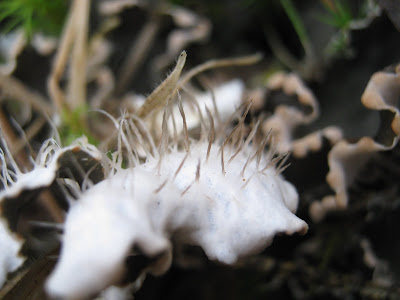
Rhizinae of the Dog Lichen, Peltigera canina
References:
  1. Miadlikowska and Lutzoni 2000, International Journal of Plant Science 161 pp. 925–958
  2. Phillips 1980, Grasses, Ferns, Mosses and Lichens of Great Britain and Ireland p. 176
  3. Pyatt 1967, The Bryologist 70 pp. 326-329
  4. Lockhart et al. 1978, FEMS Microbiology Letters 3 pp. 127–130
  5. Miadlikowska et al. 2003, Mycologia 95 pp. 1181–1203

Thursday, February 3, 2011

Who Needs a Shell?

Nudibranch
Bar cephalopods, most marine molluscs move slowly, if at all. While this leaves them open to predation, tough calcium based shells provide excellent protection. The nudibranchs buck this trend. Over time, they have lost their protective armour, yet in spite of their apparent vulnerability they are rarely the victims of predators (1). The loss of shell in nudibranchs appears to be associated with the development of chemical defense mechanisms (2). In most cases these are derived from the diet of the nudibranch, however there are some species of synthesising their own chemical defenses (1).  Aeolid nudibranchs procure stinging cells from their cnidarian prey (3) and ascoglossan and aplysiid nudibranchs obtain toxic secondary metabolites as they graze on algae (4). Others obtain their chemical defenses from their diets of sponges, bryozoans and tunicates. Hypserlodoris webbi selects sponges with high levels of secondary metabolites for predation, which it then sequesters in dorsal glands for pretection (2). Similarly Hexabranchus sanguineus obtains its defense chemicals from Halichondria spp. sponges but also passes these compounds to its egg ribbons, which are otherwise defenseless (5).
Nudibranch

References:
  1. Fontana et al. 1994, Cellular and Molecular Life Sciences 50 pp. 510-516
  2. Pawlik et al. 1988, Journal of Experimental Marine Biology and Ecology 119 pp. 99-109
  3. Thompson 1976, Biology of Opisthobranch Molluscs p. 207
  4. Lewin 1970, Pacific Scientific 24 pp. 356-358
  5. Avila and Paul 1997, Marine Ecology Progress Series 150 pp. 171-180

Wednesday, January 26, 2011

Beef or Salmon? Prawns please!!!

A guest post by Ken.

The common prawn (Palaemon serratus) is found on rocky shores around Ireland. They are often trapped in rock pools at low tide but can be difficult to spot due to the transparent body but become visible when moving. A closer look reveals purplish-brown dots and lines on its body. Their antennae are very long and a toothed rostrum extends forward between the eyes. It uses its fan like tail to swim backwards if alarmed. Has a diet mainly of scavenging. (1)

Common Prawn (Palaemon serratus)
Lovell et al. performed a study on P. serratus using a combination of anatomical, electron microscopic and electrophysiological approaches involving the statocyst. In crustaceans, the statocyst is found either at the anterior end of the animal in the basal segment of each antennule, or posteriorly within the uropods, abdomen or telson. It has been known that the statocyst is used as an equilibrium organ to orientate the animal within the water column. This study used an ABR (Auditory Brainstem Response) type investigation to determine the prawns hearing abilities. To acquire an ABR waveform conglomerate responses of peak potentials are averaged, which arise from nuclei in the auditory pathway during acoustic stimulation. This work provided conclusive evidence of low-frequency sound detection of frequencies ranging from 100 to 3000 Hz (a hearing acuity similar to that of a generalist fish) by a member of the sub-phylum crustacea. For hearing ability to be attributed to an organism, the physiological response sound should be initiated by a specialised receptor mechanism and here it was shown to be generated in the statocyst. In addition, recorded neural waveforms were shown to be similar in both amplitude and shape to those from fish and higher vertebrates, when stimulated with low-frequency sound, and complete ablation of the electrophysiological response was achieved by removal of the statocyst. (2)

References:

1. Sterry 1997, Collins Complete Guide to British Wildlife p. 216
2. Lovell et al. 2005, Comparative Biochemistry and Physiology, Part A 140 pp.89-100

Monday, January 24, 2011

Sniping About the Weather

Snipe, Gallinago gallinago, feeding

The Snipe (Gallinago gallinago) is an unmistakable bird, most commonly seen in Ireland in winter when resident numbers are swelled by migrant populations from northern Europe (1). Its is similar in shape to the Woodcock and the Jack Snipe, but its size and the yellow bars on its head and down its buff-brown plumage make it easily recognisable (2). It inhabits wetlands and moors where it uses its almost disproportionally long bill to probe the mud for invertebrates. This it tends to do alone, although small groups are sometimes seen foraging together.
While there has been a decline in numbers of Snipe over the past 30 years (3), the species is so numerous that the International Union for Conservation of Nature sees it as of least concern (4). The situation may become critical however due to continued destruction of wetland habitats by draining and further intensification of grassland management (5). Most grassland systems in Ireland lack botanical diversity, being composed typically of just a handful of ryegrass species (6). This results in a lack of invertebrate numbers and development of impenetrable rhizosphere areas, making feeding for the Snipe almost impossible (7).
Habitats where feeding is easy due to wet or waterlogged soil lead to longer nesting times for Snipe (5), and while wet weather does provide this increase in feeding ability, it also brings the problem of flooding. Flooding has been shown to delay Snipe nesting by up to 70 days, suggesting they are quite weather dependent breeders.

References:
  1. Sterry 2004, Collins Complete Guide to Irish Wildlife p. 60
  2. Hayman and Hume 2002, The New Birdwatcher's Pocket Guide to Britain and Europe p. 117
  3. Henderson et al. 2002, Bird Study 49 pp. 17-25
  4. www.iucnredlist.org/apps/redlist/details/150697/0
  5. Green 1988, Journal of Applied Ecology25 pp. 79-93
  6. Byrne 2009, Euphytica 166 pp. 61 – 70.
  7. McCracken and Tallowin 2004, The International Journal of Avian Science 146 pp. 108-114